Showing posts with label fantasy. Show all posts

11/25/13

Mazes and Monsters (1982)

Rik:
Hey, wouldn't it be amazing if all this money was real?
Vyvyan:
That is the single most predictable and BORING thing that anyone could ever say whilst playing Monopoly.
--The Young Ones, "Boring"

It seems like every time there's a national tragedy on the news like a school shooting, there's always some half-crazed, loudmouthed politician who is quick to blame violent TV shows and video games for corrupting the minds of our children and encouraging them to pick up a gun and blow someone's head off.

Back in the 70's, rock bands like Led Zeppelin, Styx and ELO were often accused of hiding backwards Satanic messages in their music.

Every once in a while a kid gets a hold of a library book that their lazy parents wouldn't want them looking at and then it's cries of "take this book off the shelves children shouldn't be reading this."

And of course, J. K. Rowling got an earful when ultra-conservative Americans started thinking that the Harry Potter books were a gateway to Satanism.

Apparently there are so many ways to screw up children these days.

It was the same with RPGs in the 1980s--misinformed parents back then thought games like Dungeons and Dragons would have their kids joining a cult or something.


Mazes and Monsters is a 1982 CBS made-for-TV movie based on a novel of the same name by author Rona Jaffe, which was among other similarly-themed works based off the real-life disappearance of one James D. Egbert III, a child prodigy and computer science student at Michigan State University. On August 15, 1979, Egbert disappeared from his dorm room and entered into the steam tunnels below campus in the first of several attempts to kill himself (he eventually did in 1980). Although at the time he was suffering from depression, stress and an addiction to drugs, initial investigations into his disappearance led to the misconception that his hobby of tabletop role-playing games was the cause, and of course the media took it and ran with it.

Thankfully, in these enlightened times, nobody of sound mind believes that playing RPGs leads to violence and suicide. These days we just assume that people who play them are fat, pasty-faced nerds with thick glasses, pale skin and high sugar intake who will probably die having never known the touch of a woman.

The paranoia is gone, but the negativity sadly persists.

"Obvious exits are north, south and Dennis. Also, you can't get ye flask."

So the movie begins with a police investigation at the entrance of a cave somewhere. An on-the-spot reporter explains to us all that whatever led to this sad, sordid state of affairs began with a seemingly innocent (which it probably was) Mazes and Monsters game played by a group of students at the fictitious Grant University.

Let's meet our foursome:

Chris Makepeace from Meatballs plays JayJay, a genius who skipped to college straight from high school. He acts like a clown at parties because he gets lonely and wants people to notice him. He also has a pet mynah bird, a mother who constantly redecorates his bedroom every time his back is turned, and an odd fixation with hats. (Seriously, he wears a different hat in every scene--kaiser helmet, cowboy hat, pilot's helmet, safari hat, Sherlock Holmes hat, construction worker's hard hat...)

Wendy Crewson, who would play the First Lady in Air Force One, is Kate, a brainy girl with a history of bad relationships, which she attributes to being too smart for the boys she meets. She wants to be a writer.

David Wallace plays Daniel, a boy for whom his parents have very high expectations. He wants to go to Grant U and make video games for a living, but his parents would prefer he go to MIT and get one of those big hi-tech jobs.

Your enablers, ladies and gentlemen.

And last but not least, in his first starring role fresh off his engagement with Bosom Buddies, Tom Hanks takes the lead role as Robbie, a former Mazes and Monsters player whose obsession with the game saw him flunk out of his old school. His mother drinks, his father is strict, they often get into fights, and years ago his older brother Hall, who had entertained thoughts about running away to New York City when they were kids, disappeared without a trace.

The foursome inevitably meets on their first day of college, and when they hear Robbie used to play M&M, they invite him to join them and complete their foursome. He refuses at first, saying that he's only here to study, but eventually caves to peer pressure.

He should be reading Shakespeare. He's a SWELL author.

For the next few scenes I begin to question if Robbie actually had an obsession with Mazes & Monsters in the first place. We see him playing the game perfectly normal-like and alternately going outside, studying and starting up a relationship with Kate. What part of this screams "tabletop RPG addict"? It looks to me like it's just another harmless hobby which he partakes in moderate, healthy doses while living a perfectly normal life outside the game. And they're telling me it made him flunk out of college?

In fact the only person I AM genuinely concerned with is JayJay, who suddenly feels lonely when Daniel has a test to study for and Robbie and Kate are having a moment together.

In fact, he feels so lonely he is contemplating suicide. Maybe THEN people would notice him. And maybe people would notice him more if he killed himself in the abandoned caves near campus.

Luckily, he has a change of heart when he discovers that the caves would make the perfect place for a kick-ass LIVE ACTION round of Mazes and Monsters. So with a little convincing, his friends agree and they have one.


It is at this point where Robbie, who up to now has been a perfectly rational human being, FINALLY begins to lapse. While they are in the caves, the party becomes separated and Robbie for some reason begins to hallucinate that a monster from the game is standing right in front of him. Which in his subsequent freak out he proceeds to slay.

From then on, Robbie continues to speak in character as Pardieu the holy man, plus to add to Robbie's recurring dreams about his missing brother he now sees a strange magical guy who urges him to go on a quest to find "The Two Towers" and reach "The Great Hall" who convinces him to spend all day in his dorm room drawing maps, break up with Kate to maintain his celibacy, and finally walk out of JayJay's Halloween dorm party without returning to his dorm room.

After a while Robbie appears to have dropped off the face of the earth, and his friends get worried, especially after inspecting his bedroom and finding the very nicely drawn maps in his room. They call the police and manage to report Robbie's disappearance to Detective Mayor-of-Amity-from-Jaws while keeping their real life RPG game in the cave a secret from him, which takes us back to the police investigation at the beginning of the film to let us know all that we've finally come full circle. Eventually, Robbie's confidence in Kate suddenly makes everything clear - he has wandered into New York City and plans to jump off one of the Two Towers, i.e. one of the World Trade Center buildings, so he can reunite with The Great Hall, i.e. his brother.

Right about now would probably be a good opportunity for a Lord of the Rings joke, but I'm not all that interested in Tolkien, so I don't really know any good ones.

By the time Robbie's friends make it to NYC and set up headquarters in JayJay's re-re-re-re-refurbished bedroom, Robbie has already reached the next stage of addiction--acts of shocking violence--by knifing a mugger in an alley under one of his hallucinations.

See, this is what Dungeons and Dragons does to you! It starts with one or two harmless games, then you get hooked! Next thing you know you start LARPing and talking in character, and then come the fixed ideas, the monstrous extravagances and emotional disturbances...you can't direct your thoughts...space expands, time slows down...you're unable to resist physical emotions! Next thing you know you're lying in a gutter with 20-sided dice up your nose murmuring about elves and hobbits and orcs and damage points! It's a worse drug than H. P. Lovecraft novels, Transformers and Magic: The Gathering COMBINED!

Anyway so as not to mince words, they manage to catch Robbie and snap him out of his reverie just as he's about to leap from the observation deck.

Three months later, Kate (now writing her novel about the four of them playing the game), JayJay (now in the director's program of the theater arts department) and Daniel (who I'm sure is...doing...stuff) pay Robbie a visit at his parents' house. Robbie, having reached the final stage of addiction--INCURABLE INSANITY--is now living peacefully in what he is convinced is an inn, his payment for room and board in the form of a "magic coin" that reappears at his bedside every morning, though he is undergoing therapy. His friends, secretly lamenting that the Robbie they knew and loved is no longer here, join him on one last Mazes and Monsters game.

"Gimme all your gold, your EXP and any items you might have or I'll kill you and take them off your dead body!"

Okay, here is my view of this issue:

There is nothing wrong with escapism. In moderate, healthy doses, a little getaway from reality every now and then is a good thing. It's especially true for teenagers--kids are a cocktail of emotions in their adolescent years, and while sources of ethics, morals and guidance are important, having an outlet for their aggression that doesn't hurt themselves or anybody else can be beneficial to their development. Besides, we already have V-chips, content ratings and responsible parenting; if we just go and regulate the crap out of everything free speech protects just because it MIGHT drive someone to commit acts of violence, that's just censorship. If you take Dungeons and Dragons or World of Warcraft or any other pastime too seriously, outside of the simple hobbies that they are, then the problem isn't with the games, it's with YOU.

This is the message I CHOSE to derive from this movie. Robbie's descent into fantasy-induced madness was because of unresolved emotions after his brother's disappearance, not because of some silly game like Mazes and Monsters. His mother even tells us herself at the end of the film--he was already emotionally fragile, and the game was just an outlet. His friends are also examples--they all had issues, they played the game to escape reality, they knew it was just a game, and they all move on to bigger and better things. (If anything, I was more concerned with JayJay's hat fixation. Where is he GETTING them all?)

And Robbie too will move on to bigger and better things. Things like Apollo 13, Forrest Gump, Saving Private Ryan and the Toy Story movies.

Good thing too, because this movie is flat out ridiculous. Learning about the possible dangers of role-playing games from a film like Mazes and Monsters would be like watching Reefer Madness for its anti-drug message. An outdated product of a thankfully bygone media circus.

"Okay, but we can't stay too long. We've got an anime club meeting tonight."

10/28/13

Troll (1986)

Apartment for rent. Acquire within...

Well, I've done it. I've actually done it. I reviewed a Harry Potter movie.

With wizards and magic and everything.


Though it doesn't exactly take place at Hogwarts.


(Though the castle in the title card looks like some branch campus. Or maybe the Hogwarts university hospital.)

Yes, it's the 1986 cult classic Troll. Directed by John Carl Buechler, horror movie makeup man who also made Friday the 13th Part VII.

One of many creature puppet films to emerge from the popularity of Gremlins, in a list that includes Ghoulies, Critters and *cringe* Hobgoblins.

The alleged predecessor to Troll 2, regarded as one of the worst movies ever made and I'm told has about as much to do with this film as Halloween 3 has to do with the rest of the Michael Myers franchise. (You know, that one where that kid witnesses a girl being eaten unaware that a fly has landed on his forehead - OH MY GAWWWWWWWWWWD!)

"Pulls our finger, my precious..."

We begin with the Potter family, who have just moved to a small apartment building somewhere on the streets of San Francisco. Little Wendy Potter, played by Jenny Beck from V: The Final Battle, plays ball by herself when she wanders into the basement and is attacked by some kind of...well, troll who uses a ring on his finger to assume her corporeal form and then proceeds to run around the building annoying everyone inside, screaming and growling and biting and going into conniptions.

The only person who seems to notice something is amiss is the son of the family, a monster movie fanatic named Harry Potter, Jr., played by Noah Hathaway, best known for playing Atreyu in The Neverending Story.

Yes, that is his name. HARRY POTTER, JR. His father, played by Michael Moriarty who spent four seasons on Law & Order, is HARRY POTTER, SR.

Despite what this film's producers might think, I'm fairly certain these names are just a coincidence. There's also a "Harold Potter" in an early Monty Python sketch about blancmanges playing at Wimbledon, and THEY haven't mentioned anything about it, so I would imagine it's more common a name than people think.

Though as Atreyu, Noah Hathaway WAS probably the Daniel Radcliffe of his day.

Speaking of names, Noah isn't the only interesting casting call in this movie. Check out who else lives in this building:

June Lockhart from Lassie and Lost in Space plays Eunice St. Clair, an nice sarcastic old lady who knows more about these creatures than appearances would dictate. As if the living, talking mushroom casually disguised as a table lamp wasn't a tipoff.

Gary Sandy from WKRP in Cincinnati plays Barry Tabor (spelled as shown in the credits and yet with a Y on his doorknocker), an ex-Marine who's always going on about communists and doesn't read books because liberals publish them.

Phil Fondacaro, who played a dead Ewok in Return of the Jedi, plays an English professor who is dying of bone marrow cancer. He also pulls double duty as the troll wreaking havoc around the building.

Seinfeld's Julia Louis-Dreyfus makes her feature film debut as Jeanette, an...actress or something? I wasn't made clear on that.

And finally, future congressman Sonny Bono (yes, the one who was married to Cher) plays a desperate, lonely, perpetually horny gigolo who--


Euugh! Ohhh, he looks like Carl from Aqua Whatever They Call That Show Now! Ugggh, I hate those tyoes of characters!

Oh yeah, and his name is "Peter Dickinson." Cue Beavis-and-Butthead laughter.

It isn't long before every apartment in the building apart from Eunice's and the Potters' are overrun with little magical gardens, its residents transformed into giant turds that sprout mystical vines and grass everywhere (Julia Louis-Dreyfus also turns into a nymph, while the dying English professor wishes he could be reborn into a magical land of unicorns and things and the troll is all too happy to oblige) and are soon crawling with other mystical creatures.

Oh, and they sing too. Here, have a listen:


Are those lyrics Latin? I can't be sure.

Anyway, his younger sibling's erratic behavior coupled with some ideas some bad monster movies put in his head have convinced Harry Jr. that the psychotic little she-demon in her little sister's body is not his little sister. Luckily his new friend Eunice, who is the only one in the building to notice that people are disappearing like rabbits, knows why.

Okay, this is actually a little convoluted...

For those of you who don't like spoilers, here is a picture of a younger Julia Louis-Dreyfus as a nymph to distract you from reading the following paragraph.

Oh. You're above being tempted by sexy nymphs. Okay then...

Long ago, before countries existed, there was a human kingdom and a fairy kingdom, and both of them got along with each other quite well. Torok and some of his fairy friends wanted to overthrow the human kingdom and rule the world, but they ultimately failed and Torok was turned into a troll for his trouble. Eunice has been living in the building for centuries, keeping an eye on Torok. It was he who has been growing little ecosystems throughout the building, and once he's furnished each apartment in magical kudzu, the fairy world will burst forth into the human world and...war will probably be waged, scientists will freak out, Pat Robertson will say the state of California had it coming, and the florist industry will enter a future more prosperous than anyone could imagine. Wendy is still alive somewhere in this mess, soon to be christened by Torok as the "princess of the fairies".

Uhh...did anybody else know about the inter-dimensional gateway in the basement of this seemingly normal apartment building? Maybe Eunice would have WARNED them or something? There were at least four other people living in it. I think one of the first things I'd like to be sure of when moving into a new apartment is that it was rat-, vermin- or fairy-dimension-free, because if I got sucked into some mystical fairyland while I was washing my clothes, I think I'd want my deposit back. I certainly wouldn't let my kids wander down there to get abducted by vengeful goblins or anything.

Okay, who gave the kids sugar?

Eunice sends Harry Jr. deep into Middle Earth with a sword with which to stab the heart of Torok's universe and rescue his sister while she changes into June's daughter Anne Lockhart from Battlestar Galactica, goes off to face Torok, and ends up as a tree stump.

Harry Jr. fares slightly better. He DOES manage to find his sister in a Snow-White-esque glass box and releases her, but he doesn't exactly stab the heart of Torok's universe, which is actually the biggest friggin monster we've seen throughout this film. No, Torok inadvertently does it himself when the monster tries to attack his queen Wendy after tossing Harry Jr. to one side.

Uhh...whoops. Guess you shouldn't have made the heart of the universe something that could be easily killed.

Anyway, to wrap up, brother and sister escape as the magical world collapses, the house stops sprouting weeds everywhere, Eunice is okay, the family moves out of the apartment, the other tenants...I don't know, probably dead, and a policeman goes to investigate the basement exemplifies what I was saying about leaving an inter-dimensional gateway unchecked in an apartment building.

"All right, son. No more Syfy original movies for you."

Troll is a weird movie. Every bit of it. From its characters to its singing goblins to a younger sister who could serve as an inspiration for leash laws for children...even its young hero and his neurotic obsession with movie monsters, even though he's the character whom nobody is expected to believe. We see him in bed watching monster movies, and then he describes his sister's behavior almost word-for-word like the dialogue in the film he was watching. Are their parents completely oblivious to the fact that the other tenants are never seen again after their daughter pays them a visit? Or that she's a good mouth froth away from going completely rabid? Or, for that matter, that their son, even though he's right in this case, is perhaps suffering from quite an overactive imagination for a boy his age? I mean, there is a line spoken by the father--"Honey, did you do a lot of drugs before we met?"--but otherwise they literally suspect nothing.

Also, watch for Michael Moriarty's not very good impression of Tom Cruise from Risky Business. Parents are so unhip.

It's also weird in that it doesn't feel like a horror film, even though it is sometimes billed as one and there is a gruesome scene early in the film in Sonny Bono's on-camera transformation into a giant plant-spewing turd. (Thank you, by the way. I don't like Quagmire characters.) Everybody else's happens off-screen, and there isn't really any blood or anything. The film doesn't take the disappearance of its supporting cast very seriously, and truth be told, it's kinda hard to take ANYTHING seriously when all your monsters take a break from their quest to rule the universe by singing some silly gibberish song.

Even though this film has decent makeup and visual effects, a once- or soon-to-be-famous cast, and something of a cult following, it is not as fondly remembered as the infamous film that was marketed as its sequel. Apparently, nothing can beat out a film with a widely circulated YouTube clip in the popularity department. Still, if you like fantasy movies about singing trolls and don't mind seeing Sonny Bono in an undershirt, then by all means go forth and conquer.

All I know is I've got that song stuck in my head now. What ARE those lyrics?

Lemme try...
"We have heard of this! It's the myriad campaign, ah!
Herbert Herbert wing, Herbert Herbert Herbert wing, dream of us!"
...this movie is weird.

7/24/13

Flash Gordon (1980)

Pathetic Earthlings...who will save you now?


Flash Gordon is a product of the science-fiction/fantasy/adventure craze that hit the comic pages in the 1930s. Created by cartoonist Alex Raymond and first published by King Features on January 7, 1934, Flash Gordon was one of many comic adventure stories inspired by and created to compete against Buck Rogers in the 25th Century, but since then has taken on a life of its own, having been reprinted many times under many publishers, adapted into a number of TV series courtesy of the DuMont Network, the Filmation cartoon studio and the Siffy Channel, and has recently been featured in the works of Seth MacFarlane, a guy who's somehow made a lot of money by trying to pass off pop culture references as jokes.

Though, to be honest, MacFarlane was not referencing the comic itself, but rather the 1980 movie based off of it.

The one produced by Dino De Laurentiis, the Italian film producer who gave us Barbarella, the 1976 King Kong remake, and both Conan the Barbarian movies, riding the wave of sci-fi/fantasy movies inspired by the original Star Wars.

The one screen-written by Lorenzo Semple, Jr., who also wrote the first Batman movie. No, the FIRST Batman movie.

The one with the kick-ass theme song performed by:


Of course it's not like there's another Flash movie out there. Apart from the serials.

Once upon a time, there was a nice, kind, benevolent emperor named Ming (played by Max von Sydow of The Seventh Seal and The Exorcist) who ruled a very far-away planet called Mongo. One day he happened upon a planet named Earth, and decided he likes it so much he wanted to play with it, with earthquakes, hurricanes, and somehow triggering nasty volcanic eruptions to terrorize the population.

Oh, did I say "nice, kind and benevolent?" I meant "horribly, horribly evil."

Looks like a cross between Bruce Willis, Fu Manchu and Queen Amidala.

Meanwhile, somewhere in the barren wasteland of somewhere in the United States, a plane is boarded by Melody Anderson playing traveling journalist Dale Arden and the star of this movie, nude Playgirl centerfold Sam J. Jones as Flash Gordon--in the original comic a polo player from Yale University, in this film star quarterback of the New York Jets.

Ming sends in a plague of "hot hail" (couldn't it just say meteorites?) which pummels the plane and somehow makes its pilots disappear, leaving Flash and Dale to try and keep the plane in the air, but despite their best efforts, it crashes into the greenhouse belonging to one Dr. Hans Zarkov (played by Topol, whom I remember as one of James Bond's allies in For Your Eyes Only), an ex-NASA scientist who believes that these disasters are the cause of an alien invasion, an extraterrestrial force that is slowly pushing the moon towards the Earth.

Zarkov doesn't seem to mind that Flash and Dale have crashed an airplane into his house. In fact, he even invites them to fly his new rocketship with him to investigate these alien goings-on. At gunpoint, mind you, but, hey, at least they get to ride a rocket.

Okay, so which one of you is Flash?

The rocket takes them all to Mongo, where they are promptly captured by stormtroopers and brought before Ming. The fuehrer decrees Flash to be executed, Dale to become his new concubine, and Zarkov to have his mind wiped for entry into his secret police, and then...a football game breaks out between Flash and Ming's soldiers. Yeah, a football game. Flash plays quarterback, Dale plays cheerleader, and Zarkov reveals that he was a first-round draft pick for the Kansas City Chiefs by accidentally braining Flash with a forward pass.

At Flash's execution, however, he is rescued at the last minute and smuggled from his coffin out of the palace by Ming's daughter Aura (Ornelia Murti) who, I've gotta be frank here, is a TOTAL SLUT. I'm not just saying that, she is literally a tease. She already has a relationship with Prince Barin of Arboria (played by another Bond actor, Timothy Dalton) yet she seduces the royal surgeon to smuggle Flash out of Ming's palace during his execution, and while teaching Flash to fly the airship that's taking him to freedom and teaching him how to telepathically contact Dale and tell him he's alive, keeps trying to put her tongue down his throat.

Hey, hands on 10 and 2, buddy.

Anyway, Aura drops him off at Arboria, which looks a lot like the Ewok village from Return of the Jedi, and returns to the palace to be interrogated and tortured. And Prince Barin proves himself to be most hospitable to Flash by locking him in a cage and dumping him in a swamp, daring him to stick his hand in a hollow tree stump that is home to a poisonous stinging thing, and then saving his live from a carnivorous plant...so as not to be denied the pleasure of killing him himself.

Eventually everyone gets abducted (including Dale, who escapes Ming's palace with a very-much-not-mindwiped Zarkov, and Zarkov as well) and taken to the airborne kingdom of Sky City, home of its ruler Prince Vultan (played by BRIAN BLESSED, who has since become the most notorious actor in this film) and his army of Hawkmen (no relation to the DC superhero). And Vultan's first official act is to have Flash and Barin fight to the death on a rotating spiked platform.

But not before Dale is briefly reunited with Flash and hurriedly pops the question to him, after knowing him for just the span of a few hours, most of which she spent unconscious flying in a space capsule.

I don't think he expects you to talk.

The battle comes to an end when in a show of good sportsmanship Flash saves Barin from falling to his death, much to Vultan's disappointment, but word has gotten out that Flash has survived and it isn't long before Min's mingions...Ming's mingings...minmingminamin...the baddies turn up and recapture everybody. Except for Vultan and the hawkmen who fled at the arrival of Ming, and Flash, who rejects Ming's offer of a kingdom of his own after seeing how he turns everybody's neighbors against each other as insurance against a possible owverthrow of government and is left for dead at Sky City as it is to be demolished.

Having conveniently found a vehicle he can ride to escape just as Sky City is destroyed, Flash must now rescue Dale from marrying the universe's biggest prick, somehow save Barin and Zarkov from execution, and though I personally don't think she deserves it, stop Aura from being exiled to the coldest, iciest, most uncomfortable part of Mongo. Tall order for a first-string quarterback.

"Errm...which one of you is the bride again?"

Luckily a newly reformed Aura escapes her own exile and frees Barin and Zarkov just as Ming's army notices that Flash is not quite dead again and sends some army guys to make him not not quite dead again. Flash thinks to the newly-displaced Vultan, and together he and the Hawkmen launch an invasion of Ming's palace and stop the wedding. This includes a flying laser battle fight scene on Ming's battleship Ajax, complete with THE BEST MUSIC YOU COULD POSSIBLY SET TO A FLYING LASER BATTLE FIGHT SCENE.

Have a listen:


Queen could make a FAMILY REUNION sound epic.

Anyhoo, long story short, Barin manages to lower the palace's lightning field, allowing Flash to suicide-plunge the Ajax into the exact spot where Dale is becoming Ming's new sexual playthi--marrying the bastard, and without even bothering to wait until the "speak now or forever hold thy peace" part of the ceremony, finally crashes, skewering Ming on the long pointy end of the vessel, where he eventually...makes himself evaporate.

Oh, yeah, and the Earth is saved somehow, I guess.

Barin and Aura become the new Emperor and Empress of Mongo, Vultan is named their new general, and a big thank-you party is thrown in Flash's honor as he, Dale and Zarkov contemplate getting back to Earth.

Meanwhile, an unknown hand picks up Ming's ring in the final shot, setting up a possible sequel that never happens.


Earthling drivers.

It's very easy to dismiss Flash Gordon as comic book camp but, let's face it, it is. Any movie where half the characters dress in silly costumes and act like they're supposed to be taken seriously IS camp in its purest form. It was written by the guy who wrote the 1966 Batman movie, and knowing the sort of material he came up with for THAT feature, of course it would be a tad theatrical. Plus, anybody who could get BRIAN BLESSED to dress up in feathery shorts and wings with no shirt on...do I HAVE to spell it out for you people!!

Don't give me that look. It's not necessarily a bad thing to be overly theatrical. Adam West's Batman is regarded not just as a TV classic, but as a major influence to certain elements of the Batman comic we know today. And Electra Woman and Dyna Girl gets a pass because, well, it's Sid and Marty Krofft and I wouldn't expect anything more or less from them. Not sure what was the deal with Supergirl, though...

I enjoyed Flash Gordon. It was very entertaining. The visual effects were nice to look at, the action was pretty good, there was obvious attention to detail paid to its source material, and, of course, the soundtrack was kick-ass. And if no one else, at least Brian "GORDON'S ALIVE?!" Blessed appeared to be enjoying himself, even if his outfit wasn't doing him any favors.

That is the face of a man whose place in pop culture has just been cemented.

12/19/12

Santa Claus: The Movie (1985)

The Prophecy has come to pass, that there would come to us a Chosen One, and that he, having no child of his own, would love all children everywhere, and that he himself would be an artisan, and a craftsman, and a skilled maker of toys.
...
From this day on, now and forever, you will bring all our gifts to all the children in all the world, and all this to be done on Christmas Eve.
...
The night of the world is a passage of endless night for you, until your mission is done. This is your legacy, and your gift, as is the gift of flight. Now, all those within the sound of my voice, and all those on this Earth everywhere know that henceforth, you will be called...Santa Claus. And now, everyone, Merry Christmas.

ANOTHER Santa Claus movie? Well, if it's Christmas...


Yes, conceived by the production team who gave you the first three Superman movies and directed by Jeannot Szwarc, whose name I still haven't learned to pronounce since I reviewed Supergirl last spring, it's Santa Claus: THE MOVIE. That's right. You can forget Santa Claus Conquers the Martians. You can forget the mystical train wreck that was Mexican Santa Claus. You can forget both the original Miracle on 34th Street AND its remake. You can forget every holiday special you've ever seen. Nope, this movie is it. The DEFINITIVE Santa Claus movie. I'm fairly certain they wouldn't have added "THE MOVIE" in the title if it weren't so.

Don't let the above title card fool you. This is Santa Claus: THE MOVIE. Finito. The end. Done.

Now then, the best way to approach this movie I've found would be to split it into two parts, since the first part of the film is very loosely connected to the second. As it's a movie about the origins of Santa Claus, I'm thinking a nice ITALIC font will suit it wonderfully. Also, you might want to bring your children closer to the screen and pretend that I'm reading this to them out loud in a warm, friendly voice.

Here we go...*ahem*

Once upon a time, many years ago somewhere in northern Europe, there lived a kindly old toy-maker and his wife (played by David Huddleston and Judy Cornwell) in a village deep in the forests. This toy-maker was particularly fond of children, but not in the kind of way that gets you sent to prison, and every year around the winter solstice, he and his wife would ride around in their reindeer-driven sleigh and give out toys to all the children of the village.

One year, there was a terrible blizzard, which did not deter the toy-maker and his wife from giving away their toys as they did every year. But while they were out there, the snow blew so hard that the reindeer could not continue, and it looked like the old couple would freeze to death in the blinding snow. Luckily, some unseen force rescues them and deposits them at the North Pole, where they are greeted by a clan of short-statured people known as "Vendequm" (or elves, if you like) who take them back to their big house sitting at the top of the world.


"It's only a model."
"Shh!"

The elves, as it happens, are toy-makers themselves, and have been seeking a middle-aged childless couple who love children dearly to help them give their toys to all the children of the world. With the help of some magical reindeer feed, he and his sleigh driven by eight tiny reindeer will fly all over the world to distribute all of the toys in one night, the shroud of nighttime travelling with him until his job is done.

Finally, the big day arrives, and as the toy-maker is about to set off, he, his wife and the elves are visited by a wise and ancient elf, played by Burgess Meredith, who gives him the name that the whole world will know him by--Santa Claus.

And so, throughout the centuries, every Christmas Eve Santa Claus and his reindeer flew all over the world giving toys to all the children, and his legend was spread to the four corners of the Earth.


All time zones meet at the North Pole, and it's always 4:20 somewhere, dudes!

Of course, over time some minor adjustments were made to the system, including the introduction of "naughty" and "nice" lists to make sure that only the good children received gifts, and Santa at one point was put on a diet after a certain poet described him as having a belly that shook like a bowl full of jelly, but nonetheless Christmas cheer was spread throughout the planet.

Well, except for the Jewish, Hindu, Buddhist and Muslim households, but I'm sure their children were still very happy.


*cough cough* Ullggh. Never doing THAT again.

Part two takes place when we finally get to the late 20th Century and involves two children named Joe and Cornelia. Joe is a homeless boy who mostly hangs around Cornelia's house and stares through her window (this is not creepy in the slightest), and Cornelia is a rich little girl who frequently leaves some food out for him and would later go on to star in The Parent Trap II. It also helps to know one of the elves whom we were introduced to in part one - the one named Patch (Dudley Moore), an inventive elf who's all about technology, modernity and bad elf puns.

And now we meet the villain of our story, a evil cigar-sucking businessman (oh, what other type is there?) named B.Z., played by 3rd Rock's John Lithgow. He makes toys too...only his aren't built as well. In fact, as a Senate hearing scene teaches us, his dolls are more flammable than napalm and his plush toys are stuffed with glass shards, nails and sawdust. Not like he cares or anything; the more profit he makes the better. He's evil, after all.

"Now let's find Donald Trump and spit on his head! Ho ho ho!"

It seems that after centuries of making and delivering toys, the parents of the world are making children too fast for Santa to keep up, so he decides to make one of his elves his assistant. The top two elves for the job are Patch and some other guy whose name I can't remember, and Patch easily wins thanks to a factory-style toy making machine he builds. While delivering these toys, Santa finds Joe, gives him a joyride in his sleigh (NOT CREEPY), tries to impress him with a reindeer trick known as the "Super Duper Looper", a 360-degree loop-de-loop trick but can't when one of his reindeer has a touch of acrophobia, then drops him off at Cornelia's.

Unfortunately for Patch, his machine doesn't prove to be as efficient as he thought, and when his new toys are returned in pieces, Patch, sensing he is to be fired, not only resigns his post, but runs away from the workshop in shame. He arrives in New York City, finds B.Z., and having no knowledge of such things as recalls, lawsuits and product safety regulations, offers to make him some money--I mean, TOYS, make him some toys--to prove himself to Santa somehow.

Five seconds of that commercial and suddenly you're too old to believe in Santa Claus. B.Z. is an evil GENIUS.

Patch's idea is to make lollipops sprinkled with reindeer feed that will make whomever eats them float in the air a la Ed Wynn from Mary Poppins. (Yeah yeah, "you should hear about what they put in hot dogs", I know.) He also builds himself a silly-looking rocket-powered sleigh to deliver them to children. B.Z. reluctantly agrees to give these lollipops away as long as he get to use the classic dope-dealer "first-batch-is-free-the-second-one-will-cost-ya" business model.

Ehh, I prefer happy thoughts and pixie dust. Organic ingredients, fewer calories and no added sugar.

Despite the lack of FDA tests for possibly harmful ingredients, and the fact that the kids are basically eating reindeer chow, the lollipops are a big hit and people all over the country are floating several feet in the air. In fact, they're so popular that apparently the police forgot all about those unsafe toy claims and B.Z. is contemplating starting a second Christmas in March to market some reindeer chow-sprinkled candy canes (I think you'd have to talk to the church about that), while back at the North Pole word of Patch's success sends Santa into a bit of a depression.

Well, maybe kids would like you more if you didn't make all of your toys out of wood. I mean, nothing against wood, it has its charm, but it's the late 20th century and I think most of the major toy manufacturers have moved on to plastics now. I mean, wood DOES have its disadvantages--it's more flammable, it doesn't break as easily, there's a risk of splinters...

Meanwhile, Cornelia wishes a merry Christmas to her step-uncle:


BUM BUM BUMMMM DRAMATIC REVERB!!

One night, while Cornelia brings a sickly Joe inside to warm up, B.Z.'s lackey Towser (Jeffrey Kramer) makes an urgent late-night house call conveniently within earshot. The kids listen as B.Z. vocally anticipating overthrowing Santa Claus and taking over Christmas to where kids will be writing to HIM for presents. Sadly, Joe sneezes, gets caught and is dragged away by the chauffeur to be bound and gagged in the toy factory (apparently the kid's movie equivalent of cement shoes), so he misses the part where Towser mentions that the candy canes explode when exposed to heat.

Cornelia, however, does not.

As they leave, B.Z. is entertaining the idea of covering up this "minor" defect, running away to Brazil and letting Patch take the fall.


It's nice and all, but do the rims keep spinning when it stops?

Patch finds Joe at the factory, discovers Santa gave him a wood carving of himself as a gift (whereas I'm sure a loving family would have sufficed in a heartwarming holiday story such as this), he takes Joe with him to the North Pole on his rocket sleigh to take the candy canes to Santa to deliver for next year. Cornelia contacts Santa for help, and the two of them chase after the rocket sleigh, which is riding along blissfully unaware that the candy canes in the back are starting to get hot.

Meanwhile, at B.Z.'s toy factory, Cornelia has tipped off the police and they've come to arrest him. After snarfing down a handful of his candy canes hidden in his desk drawer, B.Z. attempts to fly out the window to elude the cops...and quickly floats straight upwards into the Earth's atmosphere.

I think we'd better recall those Fizzy Lifting Drinks.

Back to the chase, eventually the rocket sleigh explodes in midair, sending Patch and Joe flying through the air towards certain doom, and only resolving the slightly hinted-at subplot of Santa's reindeer overcoming their fear of heights and pulling off the "Super Duper Looper" can save them!

Apparently.

The story ends back at the workshop, where Patch is welcomed home, the Clauses adopt Joe and Cornelia is allowed to stay until next Christmas. Then they all dance around in celebration.

And they all lived happily ever after.

Except for B.Z., who will eventually die of asphyxiation in the vacuum of space while his lifeless body enters a low orbit around the Earth.

"You will bow down before me, Kringle! You and one day your heirs!"

Since its release, many film critics have called Santa Claus: THE MOVIE as one of the worst Christmas movies ever, accusing the thin plot and so-called "garish" production design, while those who grew up with the film consider it a holiday favorite.

Me?

Well...I liked the first part. The filmmakers honestly try to pull off a decent Santa Claus origin story, and for the most part, it's actually pretty solid. David Huddleston does a pretty good Santa, and the special effects and the interiors of Santa's workshop certainly don't hurt. There were some things they don't really explain, though, like why all the elves gathered in one spot directly underneath a telescope and waited for a snowfall for something they called "season's greetings" which came off as kinda superfluous, but it still had its charm.

As for the second part, I can't really make up my mind about it. It is nice in places, like the parts with the kids, but as demonstrated there were some bits and pieces I couldn't help but nitpick. And John Lithgow's B.Z.--good grief. There's over the top, and then there's...that. There's evil, and then there's stuffing teddy bears with nails and sawdust and not giving a damn. There's overacting, and then there's...John Lithgow's B.Z. He comes right out of a freaking cartoon. His character is so typecast that they honestly forgot to give him some other motive than "overthrow Santa Claus."

Regardless, Santa Claus: THE MOVIE isn't really a bad film to sit through at the yuletide season. It's a little bit silly, but not to the extent of Santa Claus Conquers the Martians, and I can say a considerable amount of effort was put into it. It's a gentle, mostly harmless film, at least for children.

And the best part is we're in international waters - no adoption papers to sign!

10/20/12

The Witches (1990)

Fairy tales have always got to have something a bit scary for children--as long as you make them laugh as well.
--Roald Dahl

Ah yes. Roald Dahl. My and many a person's favorite children's author, whose books about chocolate factories, big friendly giants and telekinetic child prodigies have wowed readers for decades, and whose books have just as often been turned into feature films.


Based on the eponymous book written by Dahl (who died three months after it was released), and executive produced by Muppet man Jim Henson (who died three months BEFORE it was released), The Witches was released in 1990 to widespread critical acclaim, revitalized the film career of its director Nicolas Roeg, who had previously made independent to small-release films to less critical applause, and was nominated for five Saturn Awards and a BAFTA while its top-most billed actress won two American film critic awards.

Shame its box office takings were underwhelming. As is so often the case with the movies I do.

For the children out there who have NEVER read a Roald Dahl book before (to which I comment, what are the schools TEACHING you these days?) we're going to try something different here. The Witches is based off of one of Dahl's best novels and one of my personal favorites, and since I love it so much I don't want to deliberately spoil anything for you, so we're going to put a spoiler barrier here so you can skip straight to the end of this review without having any of the story ruined for you.

BOOK SPOILERS BEGIN HERE

Let's start with the basics: WITCHES ARE EVERYWHERE.

They don't fly on broomsticks or have warts. They look just like normal women.

They do normal things and live normal lives.

And they REALLY HATE CHILDREN. With an unbridled passion.

In fact they hate them so much they want to KILL THEM.

But not so much that they risk being sent to jail for something really horrible. No, they are much more subtle than that. Witches have an acute sense of smell which they use to sniff out a child (the clean ones smell like fresh dog's droppings to them) and then at the time when their target is least suspecting, they strike...and the child is never heard from again.

Your child's only hope is to know when they're looking at one, whether it's the rash from their wigs, the gloves on their hands, the lack of toes on their feet which makes it hard for them to wear fancy shoes, their purple-tinted eyes, or when one holds their nose when they walk by.

The common witch, shown here, is considered exactly as dangerous as Boy Scout troop leaders and Catholic priests.

Jasen Fisher from Parenthood stars as our main protagonist (let's call him Luke, since the movie kinda does, too) who lives with his Norwegian grandmother (Swedish film starlet Mai Zetterling) in England after his parents are killed in an automobile accident. His grandma's had some experiences with witches--as a child in Norway she lost her best friend to one, and she also lost a finger during an encounter with one.

"...and then the witch cut the little boy into pieces and served him up with fava beans and a nice Chianti, all because he didn't do his homework."

One day, on Luke's ninth birthday, his grandmother suddenly becomes ill. The doctor diagnoses it as a mild case of diabetes and recommends that she and her grandson take a nice seaside holiday at a fancy hotel in Cornwall so she can recover. As it happens, that same hotel is hosting the annual convention of the Royal Society for the Prevention of Cruelty to Children, a charity organization helmed by a snooty woman named Miss Eva Ernst (Anjelica Huston).

Luke's grandmother recognizes Miss Ernst, but cannot remember from where. Can't imagine why she does. I mean, Morticia Addams running a charity group? Doesn't sound suspicious to me.

As a birthday present, Luke's grandmother gives him two mice as pets, which he names William and Mary. They bring them along to the hotel, where they are quickly brought to the attention of Mr. Stringer, the hotel mana--


MR. BEAN?!?


I think my childhood just orgasmed.

Risking the wrath of the hotel staff, Luke sneaks them out of his room and into the ballroom to train them to do tricks just before Miss Ernst leads the RSPCC members into the room en masse for their meeting and lock the doors behind them.

One of them strangely starts to scratch at her scalp.

Another one Luke notices has purple eyes.

Once the doors are closed they all start taking off their shoes to reveal--

Wait, what? They're all witches? NAWWWWWW. Suerly not. A charity that aims to protect children can't possibly be trying to kill them. I mean, I'm sure their leader, Miss Ernst is a charming, generous lady who wouldn't harm a hair on their--


KILL IT WITH FIRE.

Eva Ernst, now revealed to be the Grand High Witch of All the World, wastes no time berating the witches of England for their lack of success in wiping out all of the nation's children, as the parents of England are clearly making them faster than they can kill them. She orders them to have all the children exterminated by their next annual meeting, and then introduces a new scheme with which to do so: every witch will resign from their jobs and buy a candy store where she will sell confections laced with "Formula 86", a potion of which one dose will in two hours' time turn whoever ingests it into a mouse.

I suppose it never occurred to her to find some way to discourage all the adults in England from having sex to INSURE that England will be rid of children forever. Not in a kids' book, anyway.

As a demonstration, she's invited a fat kid named Bruno Jenkins (Charlie Potter) to the meeting after giving him a chocolate bar tainted with "Formula 86" about two hours ago. The doors are unlocked, and Bruno walks in demanding the six other bars of chocolate he was promised, and sure enough, at two hours' time exactly, some wiggling, smoke effects, puppetry and reversed film later, Bruno is now a mouse of his former self.

With any luck, Bruno's testicles will quickly descend and they'll think he's a teenager.

How quickly the potion works after more than five doses soon is demonstrated when after the meeting ends, one of the witches gets a quick whiff of dog's droppings, which sends all the witches sniffing around the stage. In the ensuing clamor Luke makes a break for the doors and a chase sequence starts.

Alas, the Grand High Witch captures Luke, somehow smuggles him back into the ballroom without anyone else noticing and proceeds to pour the whole bottle down his throat. Formula 86 takes effect instantly as right away Luke shrinks down to mouse size and then escapes everyone stamping on his now empty clothes.

After finding Bruno, who has to be TOLD that he's just turned into a mouse, Luke returns to his room and explains to his understandably startled grandmother that the hotel is crawling with witches, and is very quick to formulate a plan--with his grandmother's help, Luke sneaks into the Grand High Witch's hotel room (conveniently one floor below his) and absconds with a bottle of Formula 86, which he plans to introduce into the food at dinner that night, where the Grand High Witch and her entourage, as the RSPCC, will be attending a special banquet in their honor.

Oh, get a room.

A couple of times, Luke's grandmother attempts to return mouse-Bruno to his parents, who had both also ordered the same soup that the RSPCC were eating, both times ending very awkwardly. At least the second time is concurrent with all the witches suddenly gagging and convulsing and growing fur. That and Bruno didn't have his tiny mouth full of food at the time.

With all of England's witches suddenly turning into mice, all hell breaks loose in the dining hall. Screaming, stamping, running around screaming and stamping. Grandmamma talks down the Grand High Witch has she slowly revers to rat form and then gives Blackadder the distinct honor of dispatching her himself.

Tonight, on Kitchen Nightmares...

Back at his grandmother's house, a trunk is delivered with all of the Grand High Witch's money inside, as well as an address book with the names and addresses of all the witches in America. Luke and his grandmother discuss the idea of traveling to the States as the two of them turn in for the night.

And they all, except for the witches, lived happily ever after.


Oh wait. This is the movie, isn't it? (sigh)

I have neglected to mention that in the movie, the Grand High Witch has a secretary named Miss Irvine (Absolutely Fabulous' Jane Horrocks), an abused and long-suffering subordinate who finally resigns when her boss won't let her sit at the banquet table and sends her back to her room. At the end of the movie she follows Luke all the way to his house and in the middle of the night she stands outside and shoots some beam of light out of her fingers to turn Luke back into a human being. She even gives him his glasses and his friggin mice back. Luke and his grandmother wave at her as she drives away to go fix Bruno, too.

What. The hell.

Damn it Glinda, I know witches have an image problem, but did you HAVE to bring it up in a children's film?

...and off.
BOOK SPOILERS END HERE

Roald Dahl books have not always made an easy transition to the silver screen. Ones I do remember liking as a kid were Disney's James and the Giant Peach and Danny DeVito's Matilda, though in the case of the latter the book was slightly better, and Wes Anderson's Fantastic Mr. Fox was pretty good too; however, given the family-friendly morals prevalent in all-ages cinema today, I don't think George's Marvelous Medicine would survive a trip through the Hollywood movie machine. Meanwhile, Charlie and the Chocolate Factory has already been adapted twice--the original film with Gene Wilder is considered a classic, yet Dahl hated it for deviating from the original story, a mistake which was, sadly, more grossly repeated in the ending of Tim Burton's 2005 remake, which ruined a film that was otherwise more true to the book.

Roald Dahl hated this movie too. Largely because of the ending.

Can't say I blame him. Why did they turn Luke back into a boy at the end? It doesn't make sense. What, are there GOOD witches now? Is this some Wizard of Oz-type world where there are good witches as well as bad witches? Or were the screenwriters so concerned with the film's marketability that they gave it a Hollywood ending? Weren't Luke and his grandmother about to set off to rid the world of all witches? Because this final scene sort of implies that now they don't have to anymore, and the sinister activities of a child-hating minority of women shall continue interrupted, which if you ask me is more of a downer ending that the one in the original book.

Other from that, the rest of the movie is okay. Good makeup and visual effects and great performances from Anjelica Houston and Rowan Atkinson. Overall, a very fun and enjoyable movie.

"Next ve declare var on Rrrrraul Julia. I hear he has a veakness for French accents."

8/24/12

The Adventures of Baron Munchausen (1989)

Welcome to the third and final part of our look at Terry Gilliam's


If you're just tuning in, read the introduction on my Time Bandits review.
And read
Brazil while you're at it.


I always identify with my lead characters. I was Sam in Brazil. "What will become of the Baron? Surely this time he will not escape," began as the movie's theme tune. It soon became mine.
--director Terry Gilliam

Up until Munchausen, I'd always been very smart about Terry Gilliam films. You don't ever be in them. Go and see them, by all means, but to be in them, F***ING MADNESS!
--Eric Idle


Karl Friedrich Heironymus, better known to the English-speaking world as Baron Munchausen, born in 1720, died in 1797, was a nobleman of German descent who served under Duke Anthony Ulrich II of Brunswick-Luneburg in his youth, and later fought the Turks of the Ottoman Empire with the Russian army. But he is perhaps best known for being the world's greatest liar, a storyteller who spoke of his life and adventures...or at least that's what several writers made him out to be, from which a completely fictional character named Baron Munchausen was born. This made-up Baron narrated himself as an adventurer of undeniable charisma and extraordinary luck, whose exploits included such implausible things as taking a ride on a cannonball and sailing away to the moon.

Terry Gilliam's 1988 feature was probably the fourth or fifth time the Baron's stories saw a movie release.

Time Bandits and Brazil had given Gilliam enough notoriety for Columbia Pictures to let him make The Adventures of Baron Munchausen, but it turned out to be a taxing experience for those in front of and behind the camera. It was originally budgeted at $23.5 million but wound up costing double that figure. The owners of a similarly-titled 1942 film sued the crew for copyright infringement, despite the fact that the script was based off the original public domain texts. Production was frustratingly slow, and some of the cast and crew came down with illnesses. A new company took financial control and had set a date to shut down the project, and it didn't start up again until after tense negotiations and script revisions to cut out more expensive scenes. At one point, it was rumored that Gilliam was going to be fired from his own film.

The trade press that was flashing back to Gilliam's row with Universal over Brazil had a field day, calling him an out-of-control maniac who had finally been taken down a peg.

To make matters worse, Columbia CEO David Putnam, the man who signed on the film, was ousted just as shooting was about to begin. His replacement, Dawn Steel, promptly swept all of the films that Putnam had funded prior to his departure--including and ESPECIALLY this one--under the proverbial rug.

With little promotion in bigger markets and no promotion everywhere else, Munchausen flatlined in theaters.

Shame, too. The critics and the rest of the world loved it. It even picked up four Academy Award nominations.

"And you think I'M full of it."

In the late 18th century, referred to as "The Age of Reason" in the opening caption, we open to a war-ravaged town in...France? Italy?...well, somewhere in Europe. This town has never known lower morale in its meager existence--the Turkish army just outside keep throwing cannonballs at it so often it's now on a weekly basis--every Wednesday, in fact--while the municipal government have their heads so far up their asses they've even started beheading heroic, above-and-beyond-the-call-of-duty soldiers (one of whom is Sting in a cameo appearance) for demoralizing the rest of the army.

However, these people are not too downtrodden to enjoy a nice play at the remains of the local theater, and tonight a local actor's troupe has stopped by to present "The Adventures of Baron Munchausen"...and not very well at that.

Luckily the play is interrupted by the chance arrival of the REAL (still fictional) Baron Munchausen, or John Neville playing a fancily-dressed elderly gentleman who CLAIMS to be Baron Munchausen. This man proceeds to ignore the protests of the actors, the audience and an annoyingly stuffy city official, the Right Honorable Horatio Jackson (Jonathan Pryce playing yet another bureaucrat) to proudly confess that the war they're currently...NOT fighting was all his fault.

As it turns out, the whole thing started from a bet between the Baron and the Grand Turk in which the Baron could get a bottle of wine delivered all the way from Vienna within one hour would have to forfeit his head if he were to lose.

We then cut to a flashback of this scene, where the bet turns out to be over the timely and speedy delivery of a bottle of wine from Vienna to Turkey before sunset.

Well, this is the scene where we first see the Baron's traveling companions, so we may as well meet them.


Co-screenwriter Charles McKeown plays Adolphus (at right), a marksman who would put any normal sniper to shame with his extraordinarily keen eyesight.

There's also Albrecht (center), the literal muscle of the group, played by Winston Dennis.

Gustavus (at left), a man of small stature who packs a super-deep set of lungs with which to knock many a man down just by blowing on them, completes the hat trick for ex-Time Bandit and former plastic surgeon Jack Purvis.

Speaking of recurrences, every Gilliam film I've reviewed so far has had at least one other Python appearing in it--and this one is no exception. Eric Idle stars as Berthold, who walks around with heavy balls and chains strapped to his feet so he can walk normally--because he's the world's fastest man.

He also has a fanatical hatred of tortoises.

Anyway, the Baron wins this bet by the skin of his teeth, and in celebration, he and his merry men clean out the Grand Turk's treasury room. One angry Ottoman leader later, the war began apparently.

So far in the movie, the only person who takes him seriously is the troupe leader's young daughter Sally Salt (played by a young Sarah Polley, who would grow up to star in the 2004 remake of Dawn of the Dead). Lucky for the Baron. You see, Munchausen is a tired old man with a restless, eternally youthful spirit, who resents living in a world full of order and logic and reason, much like a child with an active imagination in a technology-obsessed family or a daydreaming wage slave in a city that's choking itself to death with paperwork, and when he's backstage contemplating ending it all, she's there to inspire him to end this one-sided war once and for all.

As he tries to help the artillerymen (who otherwise couldn't be bothered--it IS Wednesday, after all), a freak trip on a cannonball and a mortar shell reveals to him that the Turks have gotten bored with calling ahead and scheduling appointments to throw heavy objects at them at high velocity and have decided to do one big final siege on the town. It's also the first we see of a hooded and caped skeleton who pops in every now and again.

Baron...you didn't use CANNED salmon, did you?

The Baron decides to search for his missing friends and ask their help to defeat the looming Turkish army. Using his charm with the ladies, he asks them to donate their bloomers to stitch together into a giant makeshift hot air balloon to will carry him out of the city and on his journey, with Sally stowing away on board.

And also the Baron has the power to make himself look younger whenever he's overcome with a sense of excitement.


What? Because he's embarking on another adventure! What did you THINK I meant?

"How on earth were you able to get enough underwear to make a giant hot air balloon?"
"...we must be close to the moon by now. Where did I leave my star charts?"

His first stop is, weirdly enough, the moon, where he claims to have last seen Berthold. Here we are introduced to the King of the Moon (credited as "Ray D. Tutto", but you probably know him as Mork) who has a history with the Baron for having an affair with his wife, the Queen of the Moon (Italian actress Valentina Cortese). Some flirting happens, they get captured, they find Berthold in the same cage with amnesia, the queen's floating head helps them escape, Bert gets his memory back, and our heroes all fall off the moon.

Oh yes, I forgot to mention that the King and Queen's bodies are both decapitated. Both their heads float around everywhere while their bodies make love to each other and generally run around like chickens with their...well, you get the general idea.

Ever since he got satellite reception, Orson's been coming in loud and clear.

Rather than orbit the Earth until they asphyxiate and die, they plop down from an impossible height into Hell.

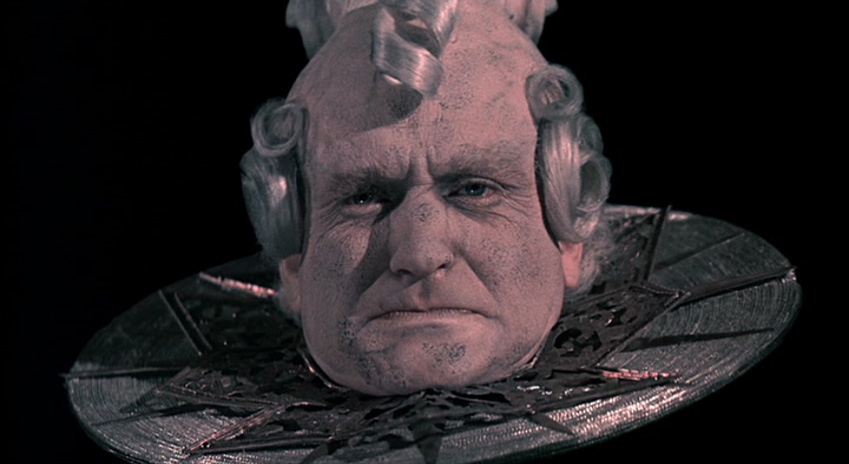
Well okay, it's not really Hell, and they're not really dead. While it IS deep below the Earth's surface, it's actually the fiery lair of the fire god Vulcan (Oliver Reed), who is actually very hospitable despite his living conditions and his visual resemblance to Brian Blessed.

Here we find out what Albrecht's been up to--he took a job as Vulcan's maid. He's got the outfit on and everything.

Yes, I know.

Everything goes fine until the easily-distracted Munchausen meets Vulcan's beautiful wife Venus (from that one painting where she's standing on a clam shell stark naked with her long hair held over her naughty bits...imagine Uma Thurman in that pose and there you go...and now go take a shower, you pervert, she was only 17). He shares a nice, romantic dance together ignorant of Sally's urgings to leave and the guy in the beard getting really, really angry. So angry in fact that he fires Albrecht and literally throws them all into the sea.

Awkward...

They emerge in the middle of a vast ocean and find Gustavus and Adolphus anticipating death in the belly of the giant fish that's just swallowed them, playing cards to pass the time. By this time Munchausen, rudely interrupted from his dance with Venus, is suddenly an old man, decrepit and depressed, and wanting his old mates to deal him in.

Hey, you know what would cheer him up right now?

One of Sally's nagging yet inspirational speeches?

Venus suddenly appearing before him?

Well, how about the Baron's trusty steed Bucephalus crashing through the wall of the ship they're staying in deep in the belly of the giant fish. Because that's what we get.

I really have nothing to say here, I just like this picture.

Suddenly inspired to head off into adventure yet again, and with the help of a "modicum of snuff", the Baron and his companions make it to shore, finally returning to the embattled city.

What follows is a very cartoonish battle sequence between the Turks and the Baron and company. The Baron, seeing his men too old to fight, decides to give himself up and allow the Grand Turk to have his head, and Sally must build up the others' resolve to rescue him. And thus starts the final battle - heads go flying off bodies, soldiers get picked off in merry-go-round fashion, ships are tossed around like a rock in a sling, and in the end the Turks are sent running and the Baron and our heroes have won the day.

Then Jackson shoots him in cold blood during his victory parade.

The 18th-century equivalent of FIRST REPLY GTFO YOUR MOM IS A HWORE YOUR GAY.

The entire city turns out for the noble hero's funeral procession, hopefully followed by the public execution of the irritable Horatio.

...and suddenly we're back in the theater.

Yes, not unlike Sam Lowry's happy ending, it turns out everything we just saw was all one of Baron's tall tales.

Mr. Wet Blanket Jackson returns to arrest the very-much-not-dead Baron for wasting everyone's time as he urges everyone to open up the city gates. Despite the annoying Horatio's persistently bothersome protestations, the whole city follows the Baron to the city gates, where just outside they discover...

...nobody there. Just an abandoned Turkish camp. (Wait, what?)

With nothing more to do in this movie, the Baron mounts Bucephalus, gives a beautiful rose to the young Sally, and with the cheers of the properly-convinced townspeople roaring behind him, he rides off into the distance and...vanishes.

Wait, so he was really dead?

But wait, that whole plot turned out to be one of his stories, so he couldn't have...

Ehh, screw it.

Haters gonna hate.


Ironic it was that a movie featuring the world's greatest liar would be, as Gilliam put it in an IGN inverview, "a victim of the world's greatest liars."

It's utterly remarkable when a movie such as this is known more for the chaos behind the scenes that in the finished product, and yet comes out as a very decent, solid effort. It isn't quite as epic or madcap as Brazil or as witty as Time Bandits, but the scale of the film sufficiently makes up for it. The visuals play out as though it were one of his Monty Python cartoons--they don't make a lot of sense, but then again they're not supposed to. And for the third review in a row, we get a WTF ending, this one more ambiguous than the other two.

Plus it has to be said: the fact that a director can put up with so much crap on the job--production delays, budgetary squabbles, miserable filming conditions (a young Sarah Polley found the experience particularly traumatizing) all for a studio that took his movie and threw it under a train--and yet make an entertaining movie that stands pretty well on its own just has to be applauded. If that isn't dedication to one's craft, I don't know what is.

And yet Gilliam's next film, The Fisher King, was also a Columbia-TriStar release.

So, how do these three films stack up against one another? Well, I'd recommend any one of them if you're looking for extravagant fantasy movies, and they all carry the theme of escapism and silliness in a world soured by rules, red tape and too much modern convenience. They all include scenes of one or more of its characters hanging from suspended cages. They have very strange endings, what with Time Bandits' exploding parents, the climax of Brazil turning out to be all in the main character's mind, and then...this. They all have Jack Purvis and at least one other Python in them...

...

I guess for me it'd be Brazil one, Time Bandits two and Munchausen a very close three.

I don't like to complicate things.

"...oh, and by the way, you know that Seven Years' War? I started THAT one as well."