Showing posts with label dystopian. Show all posts

5/6/14

Escape From New York (1981)

Shoot a cop with a gun
The Big Apple is plenty of fun
Stab a priest with a fork
And you'll spend your vacation in New York!

Rob a bank, take a truck
You can get here by stealing a buck
This is bliss, it's a lark
Honey, everyone's going to New York!

No more Yankees
Strike the word from your ears
Play the roulette
There's no more opera at the Met

This is hell, this is fate
But now this is your home and it's great
So rejoice, pop a cork
Honey, everyone's going to New York!


Hey, it's another movie about how much the future will suck! (What is this, our sixth now?)

And it's our first movie from director John Carpenter! The guy who gave us Halloween, Christine, Big Trouble in Little China and The Fog! The director who often composes the music to the movies he makes!

And it's the movie the Watergate scandal inspired him to make, even though it came out seven years after it happened!

Hey, it's that guy who appeared in four other John Carpenter movies! Including the sequel to this one!

In the far-off year of 1997, the Spice Girls reach the apex of their popularity, an over-hyped James Cameron film becomes the most popular movie in the world, the crime rate in America has increased exponentially, and the once lively city of New York has been converted into the world's largest criminal containment facility. A wall is constructed around the entirety of Manhattan, all bridges leading into the facility are mined, and guards are stationed around the perimeter. Roaches check in, but they don't check out.

I'm not exactly sure why the U.S. government decided to turn the country's largest city, a thriving metropolis with a culture all its own that millions of tourists visit every year, into a massive penal colony. There is a sequel to this film, Escape from L.A., that goes into more detail as to what kind of sick dystopian ruling party would think this was a good idea, but that's a film that wouldn't come out for another fifteen years, so this is the hand that we're dealt.

Worst. White House Easter Egg hunt. Ever.

One day, President Donald Pleasance, the man who signed off on this idea I would assume, is on his way to a summit meeting with the Chinese and the Russians for world peace or something like that when Air Force One is hijacked by terrorists and crashes inside the New York City prison. The President manages to eject from the plane in an escape pod just before it hits, but lands within the walls anyway and hasn't been heard from since. Since Glenn Close isn't here, Police Commissioner Lee Van Cleef decides to hire a felon by the name of Snake Plissken, a disillusioned war hero convicted of robbing a Federal Reserve Bank and played by Kurt Russell, to break into New York, find the Commander-in-Chief and bring him out again before his summit meeting in exchange for a full pardon.

And just to give him that extra spark of motivation, explosive charges are injected into his body that will burst his arteries and kill him within twenty-two hours, and the Commish has promised to neutralize them on return of the President.

(So they close off a whole bunch of tourist attractions--the Statue of Liberty, Times Square, every last theater on Broadway, choking off a major source of economic growth for an entire state--just to build a prison?)

They're Maggie and the Brain, yes, Maggie and the Brain...
One played a radio DJ in a California seaside town, the other a detective investigating haunted-car related murders...

Plissken enters the facility armed with a device that tracks the President's heart monitor and a countdown clock to when the explosives in his body are set off. The signals lead him to the basement of a decrepit theater, where he assumes the worst when he finds the heart monitor on the wrist of a drunken wastrel. When he contacts the police and they refuse to let him back out, a new lead suddenly emerges when Ernest Borgnine of The Black Hole appears as a cab driver who recognizes Snake at the theater, picks him and kindly informs him a gunpoint that the President is being held hostage by a man known only as "The Duke" ("The Duke of New York, A-Number One" to you) played by 70's music man Isaac Hayes.

It becomes apparent that the prisoners of New York City have somehow organized themselves into some kind of pseudo-civilization. We learn they have their own gas and oil supply, they have their own generators with which to produce electricity, and it seems they have some kind of anarchy-built political system going in which the Duke assumes a leadership position and governs the masses through antagonistic means. It also appears that this collective no such thing as social class, as the people who hang around the Duke are just as disheveled as the people who line up on both sides of the road and throw things at cars traveling on Broadway.

(What about the U.N.? Where are THEY meeting now?)

They say this Duke's one bad mother--
Shut your mouth!
I'm talkin' about the Duke!
We can dig it!

Cabbie takes Snake to see a couple of his associates - Christine's Harry Dean Stanton and The Fog's Adrienne Barbeau playing Brain, a former colleague of Snake's who now runs his own oil rig in the basement of the New York Public Library, and his main squeeze Maggie, respectively. They reveal that the Duke is holding the President as collateral to orchestrate a jailbreak across the heavily mined 69th Street Bridge, and also take him to where he is being held (with a little coercion from Snake, I assure) only for him to caught by the Duke and his cohorts.

(No more Christmas trees at Rockefeller Center Plaza?)

This must be what it's like for the President whenever Congress is in session.

Hours pass so as to increase the tension of whether or not Snake will make it out of the prison with the President and save his life and conveniently wind the clock down so that the inevitable rescue will come down to the last minute. The Duke has Snake fight who looks like a Siberian bear wrestler for his amusement while Brain and Maggie suddenly decide that they're good guys and rescue the President, while Snake kills the dude he's wrestling and all of them meet up in Cabbie's taxi for a car chase between them and the Duke. Snake's new friends are all killed one at a time while navigating the minefiend at the 69th Street Bridge while leading the President to the perimeter wall, where once his safety is finally assured, he rains hot vengeful machine gun fire on the Duke, mocking all the way.

(So NBC just cancelled Saturday Night Live? Just like that?)

And THIS must be Congress in session.

As the President prepares for a televised speech to the summit he will now have to miss, the explosives in Snake's bloodstream are neutralized with seconds to spare, and after the President thanks him for saving his life (while snubbing the people who were killed in the process), publicly humiliates him by swapping a very important tape that was in the briefcase he was handcuffed to that had nuclear secrets on it or something for a recording of "Bandstand Boogie" that Cabbie was listening to throughout the film.

(Saks Fifth Avenue? F.A.O Schwarz? Where have THEY gone?)

"Brain, get that paper out of my face, I'm trying to drive here!
Mr. President, you stop kicking Maggie in the shin right now!
Don't you make me pull this car over! I SWEAR...!"

Escape from New York subscribes to a Family Guy-style system of characterization, in that it makes most of its characters so utterly unlikable that it's difficult to cheer for them. In Snake Plissken's case, it's perfectly all right - he's an anti-hero whose only motivation for being put in this protagonist position is the full pardon, AND the people who gave him the job made him a walking time bomb. He probably didn't even vote for the guy. Ironically, his badass factor does make him an action movie guy you can get behind, even though his total kill count is, like, TWO.

(What about the Macy's parade? Is there still even a Macy's?)

Everyone else I'm not really compelled to give two craps about. Brain kinda waffles between whether he wants to be on Snake's side or not until the last moment, Maggie doesn't really do much of anything until she tries to avenge Brain's death without success, President Pleasance turns out to be kind of a dick (which I could also give a pass in a Watergate-inspired movie), and as for Cabbie...okay, I kinda liked Cabbie. He was the fun one, even though he's got a bit of a mouth on him.

If I could recommend this movie for any reason, it's to see Kurt Russell as Snake Plissken, a man who is overqualified to enter the maximum-security hellhole of a city-sized penitentiary and come back out again with all his teeth, all his fingers and one and two-thirds functioning legs.

(Where's the ball gonna drop on New Year's Eve? ...oh, right, in their juvenile offender wing)

So what do we call you? "Snake" or "Plissken?" Or perhaps "sir", that works just as well.

2/28/14

Overdrawn at the Memory Bank (1983)

Caught in a future world, his only escape is back in time!
--the tagline on the VHS cover, which is odd since the film doesn't mention time travel

Why don't you "reconst" your "Flavo-Fibes"?!
-Tom Servo

Is it just me, or have I been getting a lot of movies telling me the world will suck in the future since I started this blog?


Overdrawn at the Memory Bank is a 1983 TV movie filmed in Canada and bankrolled by public television station WNET in New York. It was intended to be part of an ongoing series of PBS-funded productions adapting various sci-fi novels (in this film's case, a 1976 short story written by John Varley) but ended up being the last of only three because of lack of funding. The film was not a critical success and since then was re-aired a few times on the Sci-Fi Channel, including in an episode of Mystery Science Theater 3000 during its eighth season, which also featured fake pledge drive host segments.

To think, your tax dollars helped fund this movie.

You don't have to be computer-simulated to work here, but it helps.

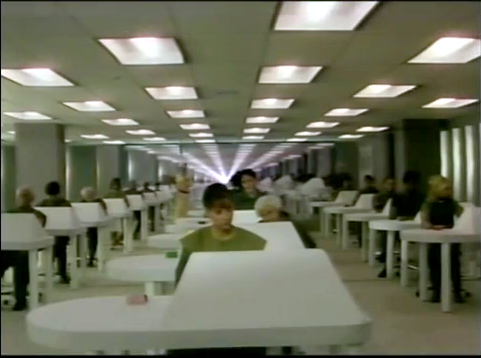
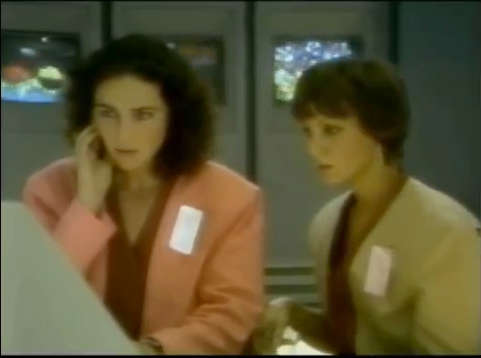
In what is yet another in a ever-lengthening list of dystopian movies I have come to review on this blog, this faux-Matrix world is entirely computer-controlled and ruled over by a number of super-duper-maxi-mega-multi-million-dollar corporations which have assumed all power of governance and lawmaking and general bossing-people-around-type affairs. The late Raul Julia, known for such films as The Addams Family, Addams Family Values and I am certain many others, stars as Aram Fingal, a programmer for one of these big companies (named "Novicorp" for the sake of convenience) who's one of those annoying people at the office. You know the type - never does his job, sits at his desk staring at Facebook posts, spends all his time at the water cooler chatting up secretaries, we've all seen them. Only instead of Facebook, Fingal just sits as his desk downloading old movies like Casablanca (or in this film's futuristic lexicon, "scrolling up cinemas") on company time.

Well, one day, his superiors finally catch him in the act and order him to visit his "psychist", an old lady who has to be prompted to ask him about his mother by the big all-seeing computer with an electronic disembodied voice that exposits absolutely everything that happens in this film. His "psychist" orders him to 48 hours of compulsory "prophylactic rehab", which consists of inserting him in a virtual forest with his mind placed in the body of an animal, or "doppling" him as they call it. It's sort of a forced vacation, though if you ask me, it's more like they give him some juice (or "reconst", whatever that means), knock him out, cut his head open, stick some electrodes in his brain and have him narrate over some stock film ripped from a nature documentary.

Fingal, as it happens, is also very poor, so rather than be doppled into a horse or something nice yet very expensive, he ends up inside the body of a baboon named Daisy.

It was either that or go in as an anteater. Vile, stupid, hateful creatures.

Either he's being doppled or he's part of a focus group for an Adult Swim pilot.

All goes well in his little dopple universe/nature documentary footage. He skitters around the place, gets drunk on nature documentary footage maruba fruit with his little animal friends, and just chills. However, when he's threatened by a nature documentary footage elephant, he requests to be pulled out of there, but there's a bit of a problem with that - you see, at the same time some grade school kids are going on a field trip of the doppling facility, touching people's brains and unbuttoning their tops, when one perverted little urchin in particular for some reason switches Fingal's tag with somebody else's, and now his body has gone missing.

When word of this gets out to the rival companies, Novicorp's stock plunges, and the appropriately fat, appropriately evil Chairman (Donald C. Moore) is considering having Fingal terminated to recoup their losses, but Fingal's dopple supervisor, a tech named Apollonia (TV movie vet Linda Griffiths) convinces him to change his mind and have her keep Fingal's soul in their HX368 computer mainframe until they can find his body, or before his dopple time runs out and his existence is erased, whichever comes first. Of course, Fingal IS quite easily bored, and she would have to keep an eye on him so he doesn't start screwing with the computer's source code.

You can already guess how that will turn out.

"I'm getting something...Novicorp...can...suck...my...HEY!!"

Fingal wakes up in a computer simulation of his own bedroom and tries to phone for help, but is only informed to go to work as normal. Apollonia must enter the simulation and explain to him that he can create his own reality simulation in the HX368, but he must create a reality as normal as possible to make it easier to track him.

And how does she enter the simulation? AS FINGAL'S LONG DEAD MOTHER. Yeah, THAT'S normal.

Well, at least this scene gives us the film's most unintentionally funny line - Raul Julia asks "Mom...am I nuts?" and it comes out "Mom...my nuts?"

By the way, Fingal is played by a Puerto Rican actor, but his mother is Caucasian? How does that work?

"Well, I had a little fling in San Juan, one thing led to another, and then..."

Anyway, for some reason the Chairman decides to undermine Apollonia's efforts by hacking the simulation to chase her Fingal's-mother character to run into the path of a simulated truck.

From there, it isn't long before Fingal's turned the inside of Novicorp's mainframe into a cheap Casablanca set, complete with a virtual reproduction of himself playing Humphrey Bogart and an unnamed neurotic virtual guy as Peter Lorre. Apollonia and the Chairman pop in and out frequently, the former to try and keep him in line and slowly become the love interest, the latter as the "Fat Man" who comes in to make vague threats and generally make life difficult for them.

Of all the scenes in all the movies in all the world, they reference this one.

Eventually, after extensive periods of boredom which included sleeping with one of his lady coworkers and even finding THAT boring, Fingal gets tired of waiting for them to pull his mind out of the machine and decides to find his own way out of the HX368 by punching in numbers at random, despite the fact that tampering with the programming could have devastating effects in the outside world it controls. After numerous attempts, he stumbles onto the access code quite by accident - IY479.

So the name of the computer is HX368 and the password to access it is...IY479. The letters and numbers that follow each letter and number in the name of the computer. That's the kind of thing an idiot would have on his email account. I'm surprised it wasn't 863XH or 12345 or the Chairman's wife's name spelled backwards.

Anyway, some cheesy video effects and random falling snow later, we've found he's hijacked the weather control system and is now wreaking meteorological havoc all over the world. Or so the graphics tell me.

WHOOOOOO, FUTURISTIC! WHOOOO...

Apollonia reappears to Fingal for some reason dressed as Venus in a clam shell from the Renaissance painting (or, if you want, think Uma Thurman from The Adventures of Baron Munchausen) and tells him to stop again. Fingal complies...for about five minutes, until another visit from the Fat Man changes his mind again. He also deduces that the Chairman is using Apollonia to track him down and badger him. He tries to regain access, but luckily the CEO has added another security lock to the system to keep Fingal out, but he gets back in anyway by just "reversing the access code."

So now it's...974YI? ...How did this guy get to be CEO of this company again?

Anyway, THIS has the effect of spitting Monopoly cards out at everybody in the building, as Novicorp's finances are redistributed to the proletariat masses.

Meanwhile, Fingal's body is finally recovered. Turned out he was in the sex change operation queue. Go fig.

EPIC STARING CONTEST ACTION!

What happens after that is very, VERY confusing, so I'll just skim through it. The Chairman finally decides that Fingal must die and re-enters the computer via Apollonia for a final confrontation, promptly shutting her out entirely somehow, the ensuing meeting leaves virtual Fingal and the little guy shot, a cheesy spinny virtual effect appears out of nowhere in front of Fingal which he grabs somehow and screams "I'M INTERFACE" at the top of his lungs, and then he stands in front of the Fat Man who starts convulsing for some reason, and they both just stare at each other for a full minute before Fingal shoots some very large pixels out of his eyes and vaporize the Fat Man.

...ah calls 'em as ah sees 'em.

Some MORE cheesy video effects later, Fingal returns to his body, and he and Apollonia make out a little before he erases their identities, assigns the Chairman a month's compulsory rehab (as an anteater, appropriately enough--serves him right, the bastard) and programs every screen in the building to scroll up Casablanca before the two of them leave the room, free from their corporate yokes.

"Look, I've Photoshopped the Chairman's face onto an anteater! ...I think I've improved the anteater!"

Overdrawn at the Memory Bank wants to be a good movie, I can feel it. Deep down inside it wants to be a decent sci-fi movie. Sadly, it comes up short in this because of three reasons:

One: the visuals in this film are not the least bit pleasant, at least when it's not nature documentary footage. The filmmakers' decision to shoot this movie on cheap-looking videotape instead of film is glaring, and the chroma key and blue screen special effects only heighten the level of its ugliness. I was half-expecting Mr. T to come out and teach me something about self-esteem. The climax practically thrives on them to the point where you have no idea what's going on. Not to mention it looks horrifically dated three decades after the fact, and the music and sound effects do nothing to help.

Two: it tries to pass itself off as futuristic by giving everything silly futuristic names. It rips a page out of George Orwell's 1984 by trying to invent new words for things. Money is called "credits." Movies are renamed "cinemas." Even potato chips are renamed "Flavo-Fibes!" It's cute and all, but in a few cases it gets really confusing and unnecessary. I mean, what the hell is "reconst" supposed to be anyway? Water? Beer? Medicine? Whatever was in Fingal's cup at the doppling table could have been wallpaper paste for all I know.

And three: corporation that is so glaringly evil and yet so grossly incompetent that the concept of network security eludes them. This is a guy who could hack into their server and watch illegally download movies on company time, and they put an access code to their most delicate software that is so simple a grade school kid could crack it? And then when he tries to get back in, they put in ANOTHER access code that he literally cracks in seconds?

In short, this movie is one part cheap Orwellian sci-fi, one part plot enigma, one part computer graphics vomit and one part low-budget Casablanca ripoff. I can't think of any other reason not to recommend this movie that the Anteater Anti-Defamation League can't provide.

"JETSONNNNNNNNNNNNNNNNNN!!"

8/3/12

Brazil (1985)

Welcome to part two of our look at Terry Gilliam's


All you latecomers can check my discussion of
Time Bandits for a proper intro.
Then come straight back here, and head on over to
The Adventures of Baron Munchausen afterward.
Everyone else...<hr> tag.


Dear Sid Sheinberg,
When are you going to release my film, 'BRAZIL'?
Terry Gilliam

This was from a full-page ad that Gilliam took out in a 1985 issue of Variety. It was addressed to Universal Pictures head Sid Sheinberg, whose company had obtained the U.S. distribution rights to Gilliam's newest movie Brazil, but were holding off on its release. The studio didn't think that the original ending of Gilliam's cut would test well with audiences and were toying with the idea of re-editing the film to give it a "happily-ever-after" ending to make it more marketable.

Gilliam disagreed with this idea, and for a while Brazil was left in cinematic limbo while the director fought with the studio. In the meantime, Gilliam held several unapproved private screenings of the film to Hollywood critics and to students at a lecture at USC. It managed to impress the Los Angeles Film Critics Association enough to be named Best Film of the Year, and with such praise Universal had no choice but to give in to Gilliam's demands and release it unedited.

The movie finally came out stateside in December of 1985, ten months after it premiered in Europe. Of course it wound up making more money there than it did here, but it's a cult classic now, so who cares.

And it didn't stop Sheinberg from releasing a 94-minute "Love Conquers All" version which actually made it to television.

We'll be looking at the original two-and-a-half-hour cut because a) I don't like watching re-edited movies, and b) I don't care much for Hollywood endings.


The film takes place, as the opening captions dictate, "somewhere in the 20th century", which would probably suggest an alternate timeline in world history, in a city not unlike that in Willy Wonka and the Chocolate Factory, where everyone has either a British or American accent. The Ministry of Information, the all-knowing, all-seeing body that rules over wherever this movie takes place, rules with an Orwellian fist thanks to its system of charging suspects for their incarceration and the information they interrogate them for.

It's a system which values efficiency, and little else...especially not building safety codes. You see many many ducts and pipes coming out of the walls and the ceilings of everywhere. It's very claustrophobic and I'm not even sure most of them are even for heating and AC. But they don't care. The movie even starts with a commercial advertising new designer ducts at your local Central Services showroom.

Oh yeah, and there's the classic 1984 tactic of setting off random explosions in public places from time to time so as to make you think there are terrorists about.

"Happy Christmas, everyone! ...oh, and OCEANIA HAS ALWAYS BEEN AT WAR WITH EASTASIA."

Jonathan Pryce stars as Sam Lowry, a white-collar employee working for the Ministry. Sam is a low-level government worker, no wife, no girlfriend, he's henpecked by his mother (Katherine Helmond), an overbearing woman who along with her friends is seriously addicted to plastic surgery. At his job, he is also prone to daydreaming that he is a winged knight sailing through the skies after a beautiful maiden in the clouds.

Truly a prime candidate for the Anti-Sex League.

And that he is also David Bowie.

On this particular day, Sam is assigned by his boss, whom Gilliam has reverently named Mr. Kurtzmann (Ian Holm) to look into a clerical error where a dead fly jammed in the printer has caused a typo on a government document regarding a Mr. Harry Tuttle, a rogue element, and the subsequent wrongful arrest of a Mr. Archibald Buttle, loving husband and father of two. Apparently they'd overcharged Mr. Buttle for what little info they got out of him, and Sam is told to rectify it as well as deliver a refund check to his grieving widow (apparently Buttle's heart condition never turned up on Tuttle's papers).

Meanwhile, the Buttles' upstairs neighbor Jill (Kim Griest) is trying to get to the bottom of this whole mix-up in hopes of discovering what happened to Mr. Buttle, but the higher-ups at the Ministry refuse to cooperate and have even branded her as an enemy of the state for trying to bring their administrative error to light. And, as it happens, she looks just like the girl in Sam's recurring daydreams.

"You have the right to remain silent. Anything you sign can and will be deducted from your bank account in a court of law."

Also, on one night where the heating system in his apartment breaks down, Sam is unexpectedly visited by the REAL Harry Tuttle (Robert De Niro), a renegade central heating repair guy who left the government payroll a while back because he couldn't stand the paperwork. Unfortunately, his presence makes enemies of two Central Services maintenance guys (played by Bob Hoskins and Derrick O'Connor) who rip out all of Sam's ductwork and then kick him out of his flat so they can "fix it."

Throughout, Sam's recurring dreams start turning Freudian as he now has to save his dream-Jill from baby-faced ghouls, monsters who look very much like Mr. Kurtzmann and Mrs. Buttle and her children, and a ferocious samurai warrior sitting atop a pile of rubble all lit up in neon.

And that's about the first two-thirds of the film right there.

Also, former Time Bandit Jack Purvis appears as a rival plastic surgeon to Jim Broadbent at one of Sam's mother's fancy parties. Thought I'd mention that for continuity's sake.

Holy crap. ...is that a shoe on her head?

Using his new-found government connections--his best friend Jack (recurring Python alumnus Michael Palin) and his mother's ties to Deputy Minister Jeremiah Helpmann (Peter Vaughan), a leader who talks a lot of nonsense, most of it in cricket metaphors--Sam finally gets to meet the appropriately freaked out Jill just as she is staring down several gun barrels hoisted by many heavily-armed policemen. What follows is a chase scene where Sam tries to confess to Jill and Jill tries to lose him while driving a truck through a construction site and finally escapes through a fancy department store during a conveniently-timed "terrorist attack."

He sneaks back into the Ministry to tamper with some records to have Jill declared legally dead and call off the storm troopers, and after that he finds her again and the two of them enjoy a passionate night of romance with Jill strangely wearing a wig making her look like the damsel in distress of his fantasies.

The next morning Sam and Jill are just about to make plans for Hate Week when they are rudely awakened by the sound of policemen barging in and surrounding them with machine guns.

At least Winston and Julia both got to live.

Read the book.


"I never wanted to be a bureaucrat anyway. I wanted to be a lumberjack..."

Sam is charged with treason for abusing his position and is strapped to a chair inside of a nuclear cooling tower where his old (as in, ex-) friend Jack wears a baby doll mask from his dreams and is about to perform a very surgical interrogation. (Jill is revealed to have been shot while resisting arrest.) Suddenly a gaping hole appears in Jack's brain as Tuttle reappears with some similarly-dressed gentlemen to rescue Sam and blow up the Ministry. Guns blaze, more things explode, and we even get a nice Battleship Potemkin reference.

From this point on, things get very stream-of-consciousness. Tuttle disappears in a stream of papers, Sam arrives at a funeral for one of his mother's friends (who had died of complications from complications from complications from her latest facelift) and finds that his mom looks eerily like Jill and has become a cougar, he falls into the casket and runs through a world lifted from his daydreams with monsters and soldiers and things chasing after him, next thing he knows he's in a trailer truck with the very-much-alive-and-kicking Jill in the driver's seat. And so the two of them drive out of the city and off into the countryside, where they settle down together and live happily ever--

Hey! You! Get offa my cloud!

Oh. Err, okay. So it turns out that last bit was all in Sam's head the whole time. He's dreaming again. Jack and Mr. Helpmann observe, fear they've lost him as they exit the room and leave him alone with his thoughts, humming the title song/recurring motif.

Damn. So Big Brother wins. Again.

Or...maybe Sam does. Somehow.

Well, the audience wins, anyway, because Brazil is a freaking EXTRAVAGANZA. Screw its two-and-a-half hour running time, I loved it.

I don't see why Universal felt cutting the ending would make it a better film. It's about a guy who daydreams a lot. So what, the daydreams suddenly become real? His bosses and his mom and everything else made his life such a living hell that the fates decide to cut him a break? I haven't seen the "Love Conquers All" version, but I'd hardly think a boy-gets-the-girl conclusion would mesh well with the whole escapism theme. Besides, George Orwell's novel didn't have a happy ending either, and IT worked.

Also, typical of Gilliam's efforts, it is SPECTACULAR to look at, probably even more so than Time Bandits. A lot is made of the use of perspective in the camera work which makes for eye-popping cinematography, whereas the art design is a very unique blend of futuristic technology and retro film noir elements--I particularly liked the Ministry of Information interiors that resemble a 1940s newspaper office and the use of giant magnifying lenses and typewriter keyboards as a makeshift desktop computer.

AND its vision of modern society is frighteningly prophetic. Think about it--a consumerist people that's fanatically obsessed with money, credit ratings, and appearances, buried up to their eyebrows in red tape, plagued by invisible "terrorists" who may or may not exist, concerned with efficiency to the exclusion of most everything else including conscience or craftsmanship, and they'd never in a million years admit that they're wrong.

Not bad for a guy who admits he's never even READ 1984.

A pictoral metaphor two reviews in a row. You know I spoil you people.

6/10/12

Demolition Man (1993)

I've SEEN the future. Do you know what it is? It's a 47-year-old virgin sitting around in his beige pajamas, drinking a banana-broccoli shake, singing "I'm an Oscar Meyer Wiener"!
--Edgar Friendly

The year is 1993, and Sly Stallone's career had fallen on hard times. His reputation as an actor had been tainted with such cinematic disasters as Rocky V, Oscar, and Stop! Or My Mom Will Shoot!, and the Iron Curtain had fallen two years ago which meant there were no more Commies for John Rambo to perforate. He needed a movie to drag his star out from where others had fallen, a movie which would spark his comeback as an action star, a movie which would place him in the limelight once more.

That movie was Cliffhanger, which was a critical and commercial success and picked up four (technical) Oscar nominations.

Then, five months later, this came out:


We begin at Los Angeles in the future year 1996, which is a criminal-infested wasteland which is constantly on fire. Quite a bleak three-year outlook for the city, huh?

LAPD officer John Spartan (Stallone), a.k.a. the "Demolition Man", is called in to deal with a hostage situation in one of the apparently many crime-infested parts of the city, where criminal madman Simon Phoenix (Wesley Snipes, in a case of one man with a cool name playing another man with a cool name) is holding a busload of passengers hostage. Spartan storms a derelict building where Phoenix is hiding out, and they both get into a fight during which some explosives are set off and the building is brought tumbling down. Spartan eventually wins, and Phoenix is arrested and carted off to be frozen in a cryogenic prison.

...Well, that was a short movie. Very simple story, too. Looks like this will be a short review for a change. Hope you enjoyed reading it.


Oh wait. Spartan is arrested as well on charges of involuntary manslaughter when all the hostages are found dead in the rubble, and he gets frozen too.


Fast forward a few decades to the year 2032, where Los Angeles has merged with San Diego and San Bernadino to become the megalopolis of "San Angeles". Yes, you guessed it--it's another dystopian future movie. We seem to get a lot of those nowadays. The only difference here is unlike the other two I've covered, there isn't some ultra-violent national sport to keep the proletariat from revolting.

Here we meet our third major character, Lenina Huxley (a pre-Speed Sandra Bullock), a lieutenant in the San Angeles Police Department, which isn't seeing much action these days since the society they live in is a peaceful, puritan one organized by the city's pacifist leader Dr. Raymond Cocteau (Nigel Hawthorne). Huxley is one of those "retro nuts" you see a lot of now and then, people who are infatuated with the pop culture from a previous era; in her case, the late 20th century. Her office and apartment are decked out with all sorts of paraphernalia from this period in time, and she's seen so many action movies from way back when that her day job seems kind of boring. If only something interesting were to happen...

There's one in every workplace.

Well, careful what you wish for, because today's the day of Simon Phoenix's parole hearing. This goes south quickly when shortly after he's thawed out he manages to free himself of his restraints, dispatch the guards with some martial arts moves, and poke out the warden's eye to trigger the retinal scan security system to excuse himself from the building.

He does not know how he managed this.

He's just broken out of jail and already he's racked up six homicides and stolen a car--

Oh, wait a minute. This is too rich. They don't use the word "homicide" to describe a code 187 in 2032 San Angeles. You know what they call it now?

You really wanna know?

Okay, here it is:


I will give you a moment to process this and laugh appropriately.

Yes. It seems that there hasn't been a homicide in San Angeles for so long that they forgot what it was called and just made something up. Most of the dialogue in this film is along these same lines. What do they call a burglary, a "RobberyTheftSteal"?

Well, anyway, the SAPD's *ahem* finest are unable to restrain Phoenix--when they first approach him at a phone booth-like computer terminal, the arresting officer has to read from a small prompter becuase he doesn't know what to do--that they eventually come to realize the only way to catch an old-fashioned criminal is with an old-fashioned cop. So they dig up Spartan's ice cube in the cryoprison, thaw him out and reinstate him as a fully-deputized law enforcer. Huxley is assigned to be his partner since she speaks late 20th Century...or tries to numerous times, anyway.

Phoenix's trail leads to the San Angeles history museum, where he has found the Armory exhibit...or rather, many particularly deadly weapons stored in a glass display case which any maniac, not just Phoenix, could smash through if he used his head...or in Phoenix's case, someone else's. Spartan eventually catches up to him, and they have a tearful reunion throughout the rest of the museum, Phoenix greeting Spartan using a highly-advanced magnetic accelerator gun and Spartan using his fists.

Spartan escapes the museum only to run into Dr. Cocteau himself, but strangely he cannot find it in himself to blow his head off. The good doctor suggests that he has "someone to kill", a man who through some sort of hypnotic suggestion Phoenix knows to be named "Edgar Friendly", and Phoenix casually wanders off, not knowing why he can't shoot him.


"Oh, please, just call me 'Your Holiness'."

After this, they spend a bit of time fleshing out this non-threatening, peaceful world we've entered. Spartan has an understandably hard time adjusting to San Angeles in a future where:
  • Everyone has a bio-engineered sensor chip implanted into their skin so they can be monitored wherever they go.
  • Thanks to the 61st Amendment which apparently repealed the part in the Constitution that said the President had to be a natural born citizen, Arnold Schwarzenegger was elected to the White House at some point. 
  • A war between fast food franchises has left Taco Bell the last remaining restaurant chain.
  • The most popular radio station in town plays nothing but old commercial jingles.
  • The modern convenience of toilet paper has been replaced by "three seashells." They don't really explain how that works, so you'll just have to use your imagination.
  • Everything that has been deemed not good for you is bad, and is henceforth illegal - smoking, alcohol, contact sports, meat, chocolate, gasoline, toys that aren't educational, salt, even SWEARING is against the law. Matter of fact, there's a running gag throughout the film where anyone who cusses is ticketed for "violating the verbal morality statute."
  • Much to the delight of Republicans, religious wackos and the state government of Kansas, abortion is illegal as well. But then, so is impregnating your wife without a license.
  • Speaking of sex, it is now done without any physical contact or fluid transference with the use of neurological "thought helmets." If you want to make a baby, you have to go to a lab.

"Can't we just cuddle? ...oh, right, we can't."

We also learn that there is an underground resistance movement in the sewers of San Angeles who are reportedly organizing and plotting to overturn Cocteau's nanny state, led by this Edgar Friendly whom Cocteau wants Phoenix to kill. Spartan notices this when during a dinner date at a fancy, err...Taco Bell he chases away some subterranean ruffians who it turns out were just foraging a delivery truck for food. Spartan, Huxley, and a third cop played by Benjamin Bratt investigate further by checking out the sewers, where they discover an underground civilization of shabby-looking people who have rejected Cocteau's law and have made a crude version of old Los Angeles where they live their lives in poverty and minding their own business. This "Edgar Friendly" turns out to be Denis Leary in a trench coat, just a regular guy who likes to annoy Cocteau from a distance and just has a few friends along for no reason. Though he does sound flattered that Cocteau sent someone to kill him.

Then Phoenix arrives to shoot up the place and we get another fight scene complete with a car chase, Phoenix in a modern police car with futuristic control screens he somehow knows how to read, and Spartan in Edgar's 1970 Oldsmobile. During this tussle, Phoenix takes the time to casually mention that the bus passengers he was holding hostage at the start of the film were already dead when Spartan arrived, so he went to freezer jail for nothing. Oh, you little rascal.

By now Spartan and Huxley have put all the pieces together: Cocteau wants to kill Edgar and crush the resistance he is supposedly leading, but since ape can't be seen killing ape in the world he created and with a police department too dumb for words, his only option was to brainwash the imprisoned Phoenix into doing it for him, feeding him the knowledge,  access codes and physical capabilities he would need to do the job, and then busting him out of jail when the time was ripe. Phoenix even asks Cocteau to thaw out some of his old friends to help him out.

Here we have to wonder if Cocteau was really thinking straight. Here he is, letting one of the 20th century's most kill-crazy felons loose on the streets after years of implanting the skills of a Navy SEAL and an expert computer hacker and his only job is to kill ONE GUY? What about the harm he could do to this peaceful society, one that is actually stupid enough to keep all of their weapons FULLY LOADED behind a glass case in a museum? Did he not consider the amount of collateral damage this man might cause, as measured in destruction of property and loss of life? And what will he do when his job is finished? How is he going to rein him in? If the police can't stop him, who can? And talking of killing machines, who's to say that he won't pull a Terminator scenario out of his hat and become self-aware, rise up against his master, kill him, and then unite his fellow machines against the humans and take over the world?

Well, unfortunately for Cocteau, that last thing I mentioned is exactly what happens. Phoenix turns the tables, has one of his cronies shoot Cocteau (since he's programmed not to do it himself) and is now planning to thaw out every thug in the cryoprison to raise infinite amounts of hell on San Angeles, just like in the good old days.

And all Spartan learned in cryoprison was how to knit.

With support from Edgar Friendly and his...friends, and no help whatsoever from the increasingly boorish SAPD police chief (Bob Gunton), Spartan and Huxley infiltrate the cryoprison where Phoenix is awaiting for the final showdown. Huxley manages to take out one of Phoenix's cronies before Spartan renders her unconscious with his taser...truncheon...thing to face the big boss alone. Another fight breaks out between the two of them and Phoenix has the upper hand throughout most of it, but thanks to a smashed cryogenic fluid container, Phoenix's body is finally frozen solid and finally shattered like liquid nitrogen. Spartan escapes just as the cryoprison is destroyed by several massive explsions.

Finally, with the police chief mourning the loss of their city's leader and Edgar Friendly eager to have the party he's fought for his right to have, Spartan suggests that the two of them work together to form a law-abiding but more permissive society, and then leaves with Huxley, asking her how the "three seashells" thing works.

Demolition Man is a silly movie, a VERY silly movie. It doesn't completely subscribe to the idea that everyone in the future will wear jumpsuits and eat food pills for three square meals a day, but its depiction of a dystopian, overly sanitized society isn't taken as seriously as in other films. I'm not sure whether it was trying to criticize ultra-liberal political correctness or uber-conservative sheltering--perhaps it was more focused on the balance between order and chaos, but the extra bits like Taco Bell, President Schwarzenegger and the "three seashells" clearly have nothing to do with the plot and were merely written in for a laugh.

Also, there was also a proposed subplot about Spartan seeing his daughter after being frozen for thirty years which never gets off the ground.

Credit where it's due, however--Wesley Snipes is enjoyable as Simon Phoenix. Just look at him gallivanting around 2032 San Angeles, running rings around its incompetent police force, MurderDeathKilling people all over the place. He's like a kid at Christmas who doesn't know which present to open first. Bonus points should also go to Denis Leary, who plays Edgar Friendly as...Denis Leary in a trench coat.

Take from this movie what you will, but it's MOST DEFINITELY a silly movie.

"Now, John, about that 'fluid transference' thing..."

5/6/11

Death Race 2000 (1975)

In the year 2000, hit-and-run driving is no longer a crime.

It's the NATIONAL SPORT!

In 1971, Brock Yates, editor of Car and Driver magazine, established the first coast-to-coast drag race: the Cannonball Baker Sea-To-Shining-Sea Memorial Trophy Dash, also known as the Cannonball Run. This race, named for record-setting driver Erwin George "Cannonball" Baker who once drove from New York City to Los Angeles in a mere 53-1/2 hours, was intended to celebrate America's Interstate highway system as well as protest recently instated traffic laws, including the new 55 mph speed limit.

It was fast-paced, highly dangerous and also against the law. But when it saw a story in Time magazine in 1975, the race was already cemented in the national consciousness, and also went on to inspire a number of cross-country "carsploitation" movies during the 70s and 80s--Cannonball!, The Gumball Rally, Cannonball Run, Cannonball Run II, Speed Zone!, and the Smokey and the Bandit trilogy among others--a couple of which were screenwritten by Yates himself.

Even low-budget movie mogul Roger Corman caught the bug at one point.


His and director Paul Bartel's Death Race 2000 was one of those movies clearly influenced by the original Cannonball Run.

Not unlike Rollerball, it's a dystopian sci-fi film where America is ruled by an autocracy which opiates the masses through bloodsport.

Not unlike Rollerball, it's based off a short story, this time The Racer by Ib Melchior.

Not unlike Rollerball, it saw a 21st-century reboot--in 2008, directed by Paul W. S. Anderson, which spun off a sequel.

And not unlike Rollerball, the original is a cult classic while its remake is certified Rotten on the Tomatometer.

This looks like a job for S&M MAN!!

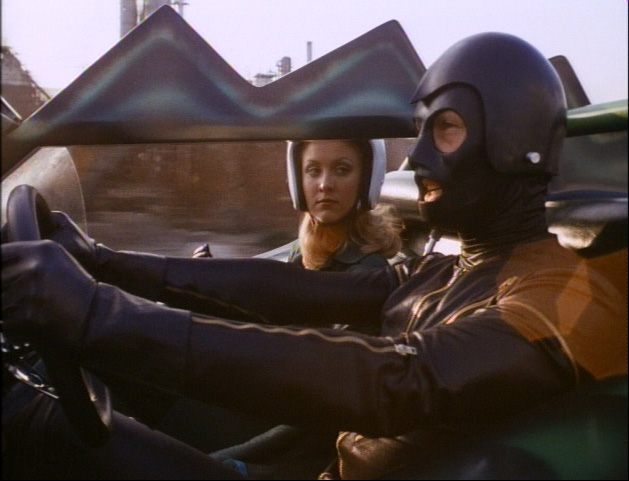
In the year 2000, following a major global economic crisis, the United States--excuse me, United Provinces of America has become a fascist, über-patriotic police state ruled from abroad by a figurehead "Mr. President" and domestically by a "Bipartisan Party", which also suggests a new union of church and state in that it is led by a deacon. To keep the working classes from toppling the ruling bourgeoisie, and as a symbol of American values and "no-holds-barred" way of life, a Transcontinental Road Race has been established, in which racers compete in a three-day rally stage from New York City to Los Angeles, with overnight pit stops in St. Louis and Albuquerque. The object is not just to finish first, but also to score the most points by running down as many pedestrians on the streets as possible. Women score 10 points more than men in any age bracket, with teenagers, children and the elderly scoring as high as 100 points a kill.

Apparently, this deacon was reading a version of the Bible where "love thy neighbor" was translated into "run thy neighbor down like a deer in thine headlights."

This year marks the 20th Annual Transcontinental Road Race, and here are your contestants:
  • "Calamity Jane" Kelly (played by Mary Woronov, the evil principal from Rock 'n Roll High School) wearing full cowgirl regalia and driving a car painted like a bull with horns welded on it;
  • Matilda the Hun (B-movie actress Roberta Collins), wearing a Nazi uniform and in the seat of a camouflage-painted racer with swastika and iron cross decals;
  • Nero the Hero (Marvin Kove, the "no mercy in this dojo" sensei from The Karate Kid), dressed as a Roman soldier and driving a modified "chariot" painted like a lion;
  • "Frankenstein" (top-most billed actor and future Cannonball Run star David Carradine), the main character, the government's hero, survivor of many races with his body rebuilt so many times they say he's more machine than man;
  • and finally, "Machine Gun Joe" Viterbo (a pre-Rocky and pre-Rambo Sylvester Stallone), Frankenstein's main rival and arguably the most easily pissed-off racer of the bunch who really, REALLY hates losing.

Throughout the race, commentary is provided by the annoying and badly-dressed Junior Bruce (radio DJ "The Real" Don Steele) and the more housewife-friendly and appropriately named Grace Pander (Joyce Jameson, with whom everyone is close friends, apparently).

A lot of the satire in the movie comes from how ridiculously popular the race is. There is a ton of media coverage from Junior, Grace, and the obligatory dude who talks like Howard Cosell, including a scene where Pander interviews the widow of Machine Gun Joe's first victim and even awards her a few prizes. Meanwhile the racers' fans range from rowdy to just plain suicidal--Calamity Jane plays toreador with a fan dressed as a red cape-toting Spaniard before eventually goring him, and a member of Frankenstein's fan club offers herself to him while he's resting up in St. Louis...to run her over, I mean...with his car. Even a geriatric hospital is holding a "euthanasia day" where they line up some patients in the middle of the street so Frankenstein can score some easy points. (He turns them down and opts instead to relieve them of a few of their staff.)

THIS is what you call health care reform?

Every driver has a navigator in this race, and this year Frankenstein has Annie Smith (Simone Griffiths) who unbeknownst to him at first is the great-granddaughter of one Thomasina Paine (Harriet Medin), leader of an underground resistance movement that is opposed to the senseless violence of the Road Race and the government that promotes it. Annie is there to lure Frankenstein into a trap, where a resistance member will hijack his racer disguised as him and deliver the group's ultimatum to the President, who has flown into New Los Angeles from his summer home in Peking to personally shake the winner's hand at the finish line.

Frankenstein sees through her ploy, but the rebels have their minor victories anyway. The race has just started when Nero the Hero targets a family picnic and drives over a baby doll holding some dynamite. Using the old cartoon staple of a detour sign and a fake tunnel, Matilda the Hun is sent driving off a cliff. And in the final leg, Calamity Jane is lured into a junkyard and blown up by a land mine.

Naturally, the government blames everything they're doing on the French, who along with their European allies have also apparently ruined the nation's economy and destroyed its telephone system.

"Damn French! We gave you Jerry Lewis and this is how you repay us?!"

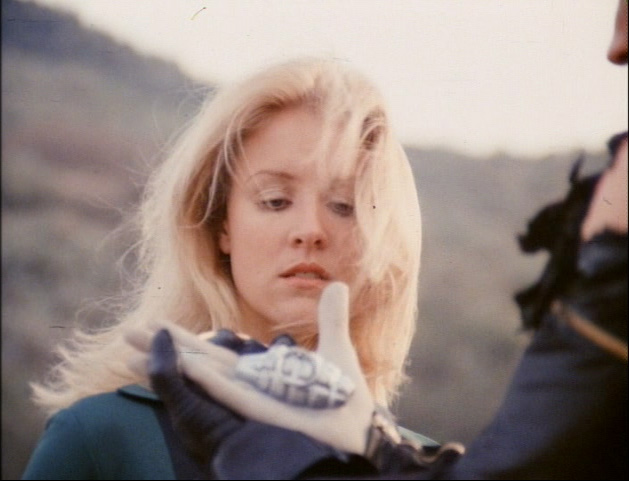
The rebels have another go at Frankenstein toward the film's climax by using a glider and some land mines to veer him off the road, but he manages to outdrive them all and even leads the aircraft into the side of a mountain in the process. (Junior Bruce cuts in to report that Frankenstein has just had a scrape with the French Air Force and "whipped their derrieres.") It seems nothing will stop Frankenstein's determination to finish first--not the resistance, not the competition, not the French (allegedly), not even Annie, who by this point has become more than just a navigator to him. And not for the reasons you might think: he knows he's just a government puppet, one of several Frankensteins bred to be drivers for this competition who can and will be replaced if need be, so he's hatched a little plan. His right glove hides a hand grenade (literally a grenade fused in the palm of his artificial hand--I hate puns) with which he plans to blow up the President during their victory handshake in New Los Angeles.

*sigh* Yeah, I know. Just roll with it.

Unfortunately, before that happens, he has one more obstacle in front of him. You see, when I said Machine Gun Joe really REALLY, hates to lose, I mean he REALLY REALLY REALLY HATES to lose. Especially to Frankenstein, whom he hates even more than losing and has even gone as far as to show open, murderous disdain for his fans. The twain eventually meet in the film's climax and by this point Joe's bile is stirred up to the point of frothing. As he is about to run Frank off the road for good, Annie twists off Frank's hand grenade...hand and tosses it in Joe's car, freaking his navigator out and forcing him off the road just in time for the both of them to be blown to smithereeneys.

In New L.A., Frankenstein is declared the winner and sole survivor and Mr. President is at a podium at the finish line waiting to shake his hand (and declare war on France). Annie walks up to the podium dressed in Frank's outfit in an attempt to knife the commander-in-chief to death, but is accidentally shot by Thomasina in the crowds. As she is helped off and Thomasina is about to be arrested, Frankenstein, who has hidden stark naked out in his car, starts it up and rams it full tilt into the podium, smashing it to pieces and thusly assassinating the President.

At the end of the film, Frankenstein is the new President, Annie has just become the new First Lady, and through their efforts democracy has been restored to America and the Transcontinental Road Race has been abolished. The newlyweds drive off to pastures new, but not before Frankenstein racks up one last dent on his bumper--the annoying Junior Bruce.

"Shut up Adrian! Can't ya see I'm tryin' to go the distance here!?"

Is Death Race 2000 supposed to be a comedy? I get its satirical points, but much of the rest of the film seem to be played for laughs, and this movie has one twisted sense of humor. A lot of it has to be seen to be believed. In the scene where Frankenstein's car veers away from the elderly targets and mows down the nurses, they pop up behind a bush like someone stuck a pin in their backside as he whizzed by. Several action scenes are accompanied by strangely cartoonish music and sound effects. I wasn't kidding earlier about the use of a detour sign and a cardboard fake tunnel as a means to write Matilda the Hun out of the film--that is EXACTLY what happens. And don't get me started on that "hand grenade" joke. One thing I can say about Rollerball is that it plays the whole American totalitarianism and devolution of society thing more seriously compared to this film, which feels more like a Roadrunner cartoon where the Coyote keeps winning.

Other than that, the movie isn't terrible for something this low-budget. Sylvester Stallone's performance as Machine Gun Joe proves he could pull off the tough guy character one year before the first Rocky movie came out, even though he loses a fistfight to his rival in Albuquerque. The production values seep through the cracks quite often and some parts of the film could be considered gratuitous, such as the nude massage scene, but the film is decently staged, and some bits of it are so silly that it makes them quite enjoyable. It's one of those "too-crazy-to-believe" movies which wallows in comedic sadism and relishes every guilt-ridden moment.

I think it might even play well in France, given the right audience.

Funny how it's the year 2000, but everyone dresses like it's still the 70s.

10/18/10

Rollerball (1975)

In the not-too-distant future, wars will no longer exist.

There will only be Rollerball.


Players divide into two teams of ten, seven on roller skates and three on motorcycles.

A steel ball is fired into the arena which one player of either team must catch with a mitt.

The object of the game is to place that ball into the opposing team's goal, while that team tries to trip you up and run you down to defend it.

Whichever team scores the most goals in three twenty-minute periods wins.

It's sort of a hybrid of football, motocross, basketball, roller derby and hockey. In that it's tactical, exciting, fast-paced, full-contact, and extremely full-contact, respectively.

A farily simple game on paper.

Also an entertaining one, considering the global balance of power rests on it and there hasn't been any wars since it was first established.

So fascinating a game that American novelist William Harrison wrote a short story about it for Esquire magazine in 1973.

Then Norman Jewison and United Artists turned it into a movie in 1975, with Harrison's screenplay.

Then John McTiernan and MGM remade it in 2002.

We'll just be focusing on the 1975 movie today.


Welcome to the future, circa 1975. Everything is all white and curvy, TV screens come in sets of four, there is wood paneling in everything, and the computers are so out of date they may as well be iMacs. It is also a future of capitalist Communism (or would that be Communist capitalism?) where nations no longer exist and corporations now run everything. It's the lobbyist's dream come true coupled with the Tea Partyer's worst nightmare. At the very least there's no more war, hunger or disease, so it's got that going for them.

And the reason there's no more war is because the powers that be have established an international rollerball league where the proletariat can vent their frustrations through watching men in crash helmets kill each other. And despite the fact that it's a very dangerous game and people have been known to die playing it, it's the only sport in business to the exclusion of every other.

That's right, all you Brett Favre and Peyton Manning faithful, someone succeeded where Jesse Ventura failed. They actually convinced the people of America that this game was a million times better and more profitable than the NFL.

Jonathan E. (James Caan) is the all-star player for the Houston team, backed by the otherwise-nameless Energy Corporation. After a successful game against Madrid, corporate executive Mr. Bartholomew (John Houseman) asks to meet with him in his office the next morning, where he lays down some conflict: he's been in the game for ten years now, longer than any other player in the league, and he's won every last award they can throw at him, so...maybe it's time that he consider retiring from the sport.

They've also signed him up for a TV special and the teleprompter they have him reading from during the "interview" from has his retirement speech typed on it. After he finds this out, he gets into an argument with his "host" and storms off the "set."

You see, Jonathan has a sordid history with his corporate overlords - his wife Ella (played by two-time Bond girl Maud Adams) was forced to divorce him when she was promised to an executive, and they've been sending concubines to his house on a regular basis ever since, though he still watches footage of Ella on every multivision set of four screens in the house.


"Why yes, I do enjoy hanging wind chimes. Why do you ask?"

After about twenty minutes of scenes establishing that this is the future that Adbusters warned us about ("privilege cards" instead of viable currency, books computerized and possibly censored) we have the next game on the schedule against Tokyo. And since they're Asians and this is 1975, they play using unorthodox skills derived from karate and aikido. For Jonathan, the rules have also been tweaked a little in an attempt to force him out of the game one way or another - no penalties and limited substitutions allowed.

Before the game, however, there is a fancy party at Jonathan's house where everybody sits down to watch his TV special - or the half-hour clip show it turned into after he stormed out. Again, Mr. Bartholomew pressures Jonathan to retire, citing that no one player is greater than the game, but Jonathan is still curious as to why they want him to quit.

Meanwhile, several guests are out in the middle of a field blowing up trees with a flare gun for no reason.


"Me hate the trees! Me hate the trees!"

Ignoring the naysayers, Jonathan decides to play in Tokyo, and the team is loudly overflowing with confidence prior to game time. With the aforementioned rule changes, it quickly descends into wanton brutality and players on both sides are killed. Houston comes away with the victory, but to them belong the spoils: during the game their lead biker burns to death when his motorcycle explodes, and several Tokyo players gang up on Jonathan's best friend and teammate Moon Pie (John Beck) and give him such a beating that the hospital he is rushed to declares him brain-dead.

Now comes the part in the movie where we actually get a message, this one about groupthink comfort versus individual freedom. An emergency meeting of the corporate heads of office reveals why they want Jonathan to retire: the original purpose of the game was not only to end all wars and fuel the working class' need for bloodsport, but also to demonstrate "the futility of individual effort", so they say, and Jonathan's rising popularity and nasty habit of surviving poses a threat to it. So it is decided that the next game, the last game of the season against the New York team, will have further rule changes - no penalties, substitutions, or even a time limit, in the hopes that Jonathan will either retire or play the game and assure himself an early grave.


Oh, this guy was amazing on the track. I heard his next of kin got a sweet shoe endorsement deal.

After much contemplation, a fruitless conversation with Zero, the world's supercomputer whose motherboard is so fried that it has managed to lose the entire 13th century, and a sudden appearance by Ella to try and talk him out of it, Jonathan is in the program for the New York game. And just to add fuel to the fire, the New York players and fans come out chanting "Jonathan's dead, Jonathan's dead, Jonathan's dead" leading up to tipoff.

The game begins, and not surprisingly the first period's not even half over before it reaches a level of violence not seen in athletic competition since the gladiator duels in the Roman empire. The crowd slowly turns silent as players on both sides drop left and right, and for added effect some of the motorcycles collide and explode, setting the track ablaze.

When the metaphorical dust finally settles, Jonathan is the sole survivor on the Houston team, and two players, a biker and a skater, remain on New York's side. Jonathan easily dispatches the biker and is just about to beat the skater to death with the ball when we get one of those tense "will-he-or-won't-he" moments where the savagery of the game stares him right in the face. He leaves him alone and casually scuttles on the tips of his skates to the goal and scores. Then he skates a victory lap as spectators slowly start chanting his name again and Mr. Bartholomew, sitting in the stands, silently exits.

I haven't seen much of the 2002 remake, but from what I can tell it incorporates a proper love interest, LL Cool J, and not so much of the global corporate domination subplot of its predecessor. It also has a 3% score on the Tomatometer, while the original has a 68.


Good thing it wasn't on "Dollar Beer Night".

Rollerball is standard dystopian science fiction fare, with a dated futuristic backdrop and classical music soundtrack seemingly inspired by Kubrick's 2001 and a tendency to tell more than show the dark oligarchic consumer culture in which it takes place. However, I am recommending it for its action scenes. The rollerball sequences are very intense and chillingly well staged; this film wasn't the first in motion picture history to include its stuntmen in the end credits for nothing.

It isn't often that I commend a movie for anything shown on screen over its plot, but then this film has something for both sides - if you don't like debates about conformity versus free will and the importance of individual identity, at least stay for the parts where rollerball players try to smash each others' faces in.


It's the eye of the tiger, it's the thrill of the fight...