Showing posts with label adventure. Show all posts

10/28/16

Deliverance (1972)

This whole movie definitely illustrates one unshakable principle: never go to the South for any reason.
-Crow T. Robot
The "Deep South" trope, as I'm sure you recall, paints a rather uncultured picture of the southeastern portion of the United States as a largely rural area populated entirely by rednecks, Southern belles, Daisy Dukes, grizzled old moonshiners, fat corrupt sheriffs, Colonel Sanders lookalikes, and people who would string you up if you ever told them the Union won the War Between the States. Everybody's inbred, everybody's illiterate, everybody carries a shotgun, everybody is suspicious of folk who "ain't from 'round here," and everybody who isn't either deeply Christian or secretly a member of the Ku Klux Klan is a psychopath who will carve you up with a chainsaw should you ever cross their path.

Of course, life doesn't always imitate art, so it would be wrong to assume that people from the South are all actually like this. But every time you watch a movie or a TV show and hear someone end a sentence with "y'all", this is where you usually end up.

Out of all the movies we've done, none of them really do much of anything to set themselves apart from this stereotype. Road House gave us a cavalcade of drunken rednecks in Missouri AND a Larry the Cable Guy clone. Texas Chain Saw Massacre...well, clue's in the title, really. And then of course we have The Giant Spider Invasion, which didn't even take place in the South. And beyond the blog, there's Smokey and the Bandit, The Dukes of Hazzard, and a number of Family Guy episodes among other examples.

And then we come to Deliverance, a 1972 suspense flick that has come to claim the unenviable title of THE ULTIMATE DEEP SOUTH MOVIE.

That was, ironically, based on a book written by someone who was living in Georgia at the time.


Basically, when one thinks of Deliverance, there are one or both of two scenes that pop into people's minds. I'm sure you already know which scenes I'm talking about, and we'll get to them in due time.

First we must establish the plot of the film, in which four city boy friends from Atlanta (played by Burt Reynolds, Jon Voight, Ned Beatty and the bad guy from Robocop and Total Recall) decide to take a seemingly uneventful weekend canoe trip down the fictitious Cahulawassee river valley for one last look at the scenery before a hydroelectric dam is built that will leave the area flooded.

Our first glimpse of hillbilly country is a gas station which looks like a rundown shack with a non-functioning rust-eaten car in front of it. Here we come to the first memorable scene from the film, in which the bad guy from Robocop and Total Recall pulls out a guitar and performs the famous melody "Dueling Banjos" with a banjo-plucking local boy who doesn't see fit to shake his hand afterward.

"I'm not allowed to play with you anymore unless y'all pay for another five minutes."

After hiring two other bumpkins who happen to own a garage to drive their cars out to their finishing point in Aintry to be picked up on Sunday, Burt Reynolds refuses to let them show him where the river is, fixing instead to just drive around aimlessly through the woods since he is quite certain that he knows so well where it is. Eventually they find it, pull their canoes out and go for a little downstream paddlin', passing underneath a bridge where our young banjo-player from earlier watches them. During the ensuing sequence of outdoor activity, Burt Reynolds establishes his character as a stoic outdoorsy type, hailing the life of a rugged nature boy over living as a suburbanite coddled by the conveniences of modern technology and predicting that the machines will one day fail and man will return to the woods in some reverse-Terminator fantasy of his.

Completely ignoring the existence of toilets, lasers and advanced medical science that have helped people live longer lives and make things work more efficiently with less environmental impact. But whatever, if you want to go back to a time where most people lived in huts, never brushed their teeth, and didn't live past their 30s. And I can only assume that one of these modern conveniences you seem to resent so much just happens to be maps.

Meanwhile, your teeth are falling out, you've got lice in your hair, and the lack of bathing begins to show.

The next morning, during another of their canoe trips, John Voight and Ned Beatty get separated from Burt Reynolds and the bad guy from Robocop and Total Recall and end up down a different part of the river, where they make a pit stop and come across two other friendly-looking locals. Who proceed to walk them further into the woods at gunpoint, tie Jon Voight to a tree, and force Ned Beatty to strip naked and...

Well, right about now you may have guessed that we've reached the other most memorable scene in the film. The infamous "squeal like a pig" scene. This is a PG-13 review of an R-rated movie, and I'm not especially comfortable describing a rape scene with the writing style I employ, so I'll just drop a hopefully somewhat tasteful picture with a humorous caption here and leave the rest up to your vivid imaginations.

"Now y'all are in a largely con-servative state, and this kinda thing is usually frowned on 'round these parts, but when y'all been livin' in these here woods fer as long as we have with very little contact with tha outside world, and mos' wimmin findja repulsive anyways...well, ya kinda stop carin' whur ya git it from next."

Thankfully before Jon Voight suffers a similar fate, Burt Reynolds shows up and pierces one of them with his bow and arrow, promptly chasing the other off.

The foursome then spend the next few minutes of the film debating the legality of their situation--whether a jury of the man's relatives (his mother, his aunt, or providing they're not one and the same, his father and uncle) would see such an act as justifiable homicide and considering that the imminent and suddenly convenient damming of the valley will get rid of the evidence - before finally deciding to give the corpse a proper burial. Then, realizing that the mountain people are easily startled but will soon be back and in greater numbers, they decide to get in their canoes and amscray.

Besides, are these the faces of an impartial jury?

During this hasty retreat, the bad guy from Robocop and Total Recall forgets to put on his life jacket and for some reason falls out of the boat into the river (later assumed to have been shot, perhaps by one of the deceased's vengeful toothless companion - suffice to say, he is not seen for most of the remainder of the film) as the boys encounter some rapids that tear one of their canoes to pieces and drops them in a basin, while Burt Reynolds breaks his leg, and about now should be considering recanting his anti-technology speech.

You know, lakes are underrated, really. They're pretty to look at, no noisy raging currents, you can swim in them, they're perfect for water-skiing...

No shattered coccyx.

Believing the other inbred toothless hick to be lurking around nearby just biding his time, and since Burt Reynolds can't be moved, novice sportsman Jon Voight is picked to avenge the death of the bad guy from Robocop and Total Recall. Climbing to the top of a rock face with Burt Reynolds' bow and arrow and staying there until daybreak, Jon Voight finds someone with a rifle looking down into the gorge and, not sure if this is the same guy who ran away from them, but probably believing all these unwashed, uncivilized rednecks to look and smell alike anyway, Jon Voight somehow manages to off the poor bastard with a clumsily-fired arrow through the chest. And only afterward does he realize that it may or may not be that guy. After coming back down the cliff with their fresh kill, they tie up the body with rocks and let him sink to the bottom of the river, as they do the mangled corpse of the bad guy from Robocop and Total Recall after finding him washed up on a nearby rapid.

In Aintry, Burt Reynolds is sent to a hospital while Jon Voight and Ned Beatty are left to work out a plausible story to cover up a potential double homicide charge and explain the fact that one of their party is missing. (To make matters worse, the deputy's brother-in-law is reportedly missing.) The sheriff, being one of those fat beady-eyed authority figures who's probably the Boss Hogg bribing type, is skeptical of their story, but since they have no evidence to hold them on, simply tells them to "go back where y'all came from." And thus the survivors of this canoe trip from hell will take these memories to their graves, secure in the knowledge whatever evidence remains will soon reside at the bottom of a dammed-up lake and Jon Voight relives the trauma in his nightmares for the rest of his life.

Someday you'll look back on this and laugh.

As a suspense story, Deliverance does its job well. A group of city slickers who come out to the country for a peaceful retreat and find themselves out of their element when things take a wrong turn, whereas Burt Reynolds, who earlier in the film comments that technology will fail, the system will break down and man will revert back to his primal stage, suddenly given a taste of the world without creature comforts and finding himself coming out the worse for wear. The scenery is very beautiful and the setting is quite picturesque, but within these thick forests hide the gunmen and rapists. Also, certain parts of the film are left deliberately vague. What really killed the bad guy from Robocop and Total Recall? Was that really the other mountain man Jon Voight arrow'd at the top of the cliff? What DID happen to that one giy's brother-in-law? You don't know. And the movie's certainly not going to tell you. To be perfectly honest, I don't think the movie knows either.

It's just a shame that the main thing that this movie is remembered for is casting a stereotypical light on the population of the Southern states and the Appalachian mountains, who already live in one of the poorest regions of the continental United States with about a third of its residents living below the poverty line, a high unemployment rate, low per capita income and little job availability, where education and living wages lag behind the rest of the country, and where you have a history of economic inequality, lack of infrastructure and political disillusionment.

And to think, the people the author based the original book on were actually quite nice.

Jimmy?

6/28/14

The Thief and the Cobbler (1993)

It is written among the limitless constellations of the celestial heavens, and in the depths of the emerald seas, and upon every grain of sand in the vast deserts, that the world which we see is an outward and visible dream of an inward and invisible reality. Once upon a time there was a golden city. In the center of the golden city, atop the tallest minaret, were three golden balls. The ancients had prophesied that if the three golden balls were ever taken away, harmony would yield to discord, and the city would fall to destruction and death. But the mystics had also foretold that the city might be saved by the simplest soul with the smallest and simplest of things.

Making a movie is not easy. All you have to do is look at some of the films I've reviewed for proof of that.

The original Casino Royale, for instance, went through six directors and had some of its stars meddling with the screenplay, resulting in a Frankenstein's monster of a spy spoof. Two of Terry Gilliam's "Trilogy of Imagination" films sunk in American box offices despite critical acclaim, either because of marketability concerns or slow production coupled with financial disputes. Life of Brian was almost never even made after the original backers saw the script and pulled their funding at the last minute.

But perhaps nobody knows more about the pain, the turmoil and the aggravation that comes with filmmaking than three-time Academy Award-winning Anglo-Canadian animator Richard Williams, who currently holds the Guinness world record for longest production time of a motion picture.

And this is the film with which he holds this record:


In 1964, Williams began production on an animated film based off a story of Eastern folklore about a "wise fool" named Mulla Nasruddin. The project went under various titles--The Amazing Nasruddin, Nasruddin!, The Majestic Fool--before they finally dropped the character altogether and went with a brand new story loosely based on its setting, thus retitling the project The Thief and the Cobbler.

And this was only the start of the film's woes--because of its complex animation and independent funding sources, the project was put on and off the shelf many times over the next two decades while Williams worked on other animation projects to raise money to finish it, including commercial work, movie credits, and even scarring generations of children for life with Raggedy Ann & Andy: A Musical Adventure and Who Framed Roger Rabbit?.

A light at the end of the tunnel seemed in sight when his work on Roger Rabbit attracted the attention of Warner Bros., who agreed to finance the film's completion, but they pulled out when work fell behind schedule. Finally in 1992, a completion bond company took over, booted Williams from the project, and finished the movie under the supervision of the quicker, cheaper producer Fred Calvert, and since it was around this time that Disney was releasing Aladdin, it was re-animated and re-edited to include musical numbers, additional voiceovers and dialogue for its two title characters (in Williams' version, the thief doesn't talk at all, while the cobbler only has one line). Two different versions were released, one in Australia and South Africa in 1993 (as The Princess and the Cobbler) and one produced by Miramax Family Films for American audiences in 1995 (first as Arabian Knight and then under its original title) in only a handful of theaters each. Neither were box office hits.

For those of you keeping score, the film started production in 1964 and was finally released by a major studio in 1995 - THIRTY-ONE YEARS. It was such a headache that Williams distanced himself from his own film, and only recently has he finally spoken out about it, having finally screened his 1992 workprint in late 2013-early 2014.

The film is technically still being made today, in a sense. In 2006, filmmaker Garrett Gilchrist released an unofficial fan-edited version, a "Recobbled Cut" if you will, a frame-by-frame restoration of the film that stitches together animatics, pencil tests and pre-existing footage from Williams'  workprint, Calvert's edition and whatever else exists to get as close as possible to the story Williams wanted to tell. It has been revised three times since then as additional footage has emerged, the latest edition as recently as last year, and considering that Williams as well as Disney and all other major animation studios have no plans to finish and release the film, I've decided to go with the more recent version, since it's about as complete a movie as we're going to get.

Don't be shy. I've reviewed cinematic fiascos before.

After a really long sequence where I imagine the opening credits were supposed to go, we are transported to a not-the-least-bit-modest Arabic setting, and a golden city. At the center of this city is a very tall, slightly leaning minaret upon which are skewered three golden balls of great implied importance. Prophesy dictates that if ever anyone were to abscond with these golden balls, the golden city would plunge into chaos and ruin.

It is here where we meet our principal cast. So let us now:

The titular cobbler, a quiet, resourceful young lad named Tack with a long, lanky, rag doll-like appearance.


The titular thief, a nameless bloke with a severe case of kleptomania, an attraction to shiny things and a lack of personal hygiene.


King Nod, an aptly-named person in that he is both ruler of the Golden City and a narcoleptic;


Zig Zag the Grand Viseer (voiced by Vincent Price in what turned out to be his final film appearance--his voice work was recorded quite early in production but the movie took so long to come out he ended up dying one month after it finally saw a theater screening) a quite slender-looking Blue Meanie who acts as the king's chief adviser, owns a perpetually-starved vulture named Phido, and speaks entirely in rhyming couplets.

What'd the bad guy from Aladdin have? A PARROT? This guy's got a friggin VULTURE. That is BAD ASS.

The King's daughter, Princess Yum Yum, a maiden fair who must have suffered some injury when from heaven she fell.


Anywho, this Zig Zag feller--loyal subject, office kiss-up, bit of a poet, but wouldn't you know it, he's actually kind of evil. We can tell this when he has Tack arrested and tries to have him executed for accidentally spilling tacks on the floor where he was prancing about in egotistical splendor and stepped on one. We later find out he plots to take Yum Yum as a bride and usurp the kingdom.

When Tack is brought before the king, Yum Yum takes pity on him and just so conveniently has a shoe in need of repair. And being the love interest that she is, a sort of blush-every-time-they-look-at-each-other-face-to-face romance starts happening between her and Tack. Kinda cute, really, even if this is all of a sudden.

"I am Zig Zag the great, and haters gonna hate!"

Meanwhile, our thief notices the golden balls at the seemingly unreachable top of the highest minaret in the city and tries various Wile E. Coyote ploys to steal them. At one point he runs into Tack and makes off with the shoe he was repairing, leading to a chase sequence that is quite reminiscent of the Loonyland castle chase sequence in Raggedy Ann and Andy. Only trippier. And nowhere near as traumatizing.


As the Thief finishes repairing Yum Yum's shoe, Zig Zag throws him into a prison cell where he is nearly fed to his vulture pet. Meanwhile the King, during one of his numerous naps, has a nightmare where the golden balls are stolen and the city is ravaged by an army of one-eyed men...which as it turns out isn't that far from the truth, really.

So, Mr. One-Eye, what are your views on gender equality in the military?

As you've probably already assumed, because we wouldn't have a movie otherwise (or what there is of a movie, anyway) the thief eventually relieves the king of his balls (yes, that's what happens) which fall in the hands of Zig Zag, conveniently when word of a one-eyed warlord's army in the vicinity reaches the kingdom. The king, rather than changing his freshly-soiled shorts, arranging some kind of search party to find his missing balls (tee hee), and perhaps fortifying the city's defenses a bit, sends Yum Yum out into the desert to consult a mad old witch for advice on what to do next. Tack, who has managed to escape his prison cell with a file and a tack, is elected to accompany her, the lucky dog.

Somewhere else, Zig Zag, having failed to use this calamity to have the king grant him Yum Yum's hand in marriage, decides to show his balls to the leader of the One Eyes (phhffftt).

Meanwhile, the thief sets off after our heroes to...do his own thing.

It's interesting how King Nod is protective of his daughter and yet trusts her to carry out this dangerous mission, let alone with a complete stranger whom she's fallen for after only meeting him just yesterday.

"Drive safely and be sure to have her home by eleven. Have fun, you two!"

After some spliced-together scenes in which the thief tries and fails to steal a ruby off the top of a sacred golden idol (where the U.S. Air Force Song is curiously playing during a moment where the thief considers flying overhead the idol's armed guards) and Yum Yum hires an out-of-work band of brigands who would probably have ransacked their caravan and carried the princess off by now were they not for the sake of the potential audience too dimwitted to realize this as their bodyguards, our heroes finally reach the mad old witch living in a rock mountain that from a distance looks like millions of disembodied hands in a big pile through an entrance revealed by the ruby. When asked about how they can save their city, rather than making quite rational claims about strategic defense formations and diplomatic solutions, points to Tack almost immediately and provides cryptic hints as to what he could possibly do, shouting "Attack! Attack! Attack!"

So Tack is destined to save the city, it turns out. Well, at least the film spares us showing him expressing his feelings of self-doubt and ruing his lot in life, wanting so much more than what he's getting, tired of people looking upon him as a lowly, insignificant shoemaker. You know, like that guy in that other movie. The one with the parrot.

As easy as it might be to make a Ghandi joke here, I just don't have it in me.

Fortunately it didn't seem like they had to travel very far, which means absolutely no side trips to strange worlds with taffy monsters, inflatable kings and stuffed camels on strong hallucinogens. Just a young man accompanying a princess on a search for her daddy's balls. (Couldn't resist, sorry.)

It also means that our heroes return to the golden city just in time to learn those one-eyed warriors have decided to pay them a visit, with Zig Zag leading the charge. And they're brought them a lovely present: a big black nasty war machine filled with soldiers, catapults and very sharp things.

Fortunately, Tack is suddenly struck with a moment of inspiration and stands before Zig Zag David-and-Goliath style armed with a piece of string and a single tack. (Get it? "A tack a tack a tack?" Hah, the witch was using a play on words, because he has a tack, and his NAME is Tack, heh heh...) Fashioning a makeshift catapult, he fires the tack at Zig Zag...and misses...but sets up a cartoon-style chain reaction that eventually destroys the One Eye army's war machine.

Figures. And they all want to watch the Super Bowl on MY TV.

The climax of the film consists mainly of the thief retrieving the three balls while the One Eyes' war machine falls apart around him, narrowly escaping numerous death traps during the meanwhilst, as Zig Zag nearly runs off with Yum Yum, fights Tack and then gets eaten by some alligators and his long-suffering bird while the brigands fight off One Eye soldiers and their leader is apparently killed. (That part consisted of storyboard drawings and wasn't exactly clear.)

Everything in the previous statement takes up about fifteen minutes of a ninety-eight minute cut.

Tack takes the king's balls (snicker snicker) back from the thief, and with that the Golden City is saved and the king in his gratitude allows the cobbler and Yum Yum to wed. Then the thief in a closing fourth-wall gag, delays the film's release even further by running off with it.

Yeah, this moment was pretty inevitable, too. Cute, though.

What this movie makes me is sad.

It isn't because of the story. Any flaws in its plot--the minimal romantic development between Tack and Yum Yum, the super-long climax, the lack of characterization of the brigand army and the One Eye warriors--can perhaps be blamed on the amount of footage that was available to piece this Recobbled Cut together. At the very least, Princess Yum Yum wasn't just written as the damsel in distress, which was nice, and even though the thief didn't have a lot to do here story-wise apart from plot catalyst, he does do comic relief duty quite well.

It isn't because of the visuals. The finished portions of the film look extravagant. Williams is known for being a perfectionist and for hiring veteran Looney Tunes and Disney artists and expecting perfection of them, and although their work here was not as appreciated by widespread audiences, the complexities of each finished scene are to be admired, and I haven't seen art design this mesmerizing since Yellow Submarine. This movie is certainly a must-see for art and animation buffs.

No, the thing that makes me sad about this film is the sheer amount of wasted potential. This movie has all the makings of an animation classic, a masterpiece, something you'd find on Turner Classic Movies on the very rare occasion that they show an animated film. The Thief and the Cobbler could have been a milestone in the history of the medium instead of the footnote it is today. Richard Williams started out all those years ago on the verge of something truly great, and if things hadn't turned out the way they had, something great is what he would have gotten.

It must feel, metaphorically speaking, like someone had ripped his golden balls off. (Sorry, that one was too easy.)

Thieves should know better than to handle another man's--okay, I'll stop now.

7/24/13

Flash Gordon (1980)

Pathetic Earthlings...who will save you now?


Flash Gordon is a product of the science-fiction/fantasy/adventure craze that hit the comic pages in the 1930s. Created by cartoonist Alex Raymond and first published by King Features on January 7, 1934, Flash Gordon was one of many comic adventure stories inspired by and created to compete against Buck Rogers in the 25th Century, but since then has taken on a life of its own, having been reprinted many times under many publishers, adapted into a number of TV series courtesy of the DuMont Network, the Filmation cartoon studio and the Siffy Channel, and has recently been featured in the works of Seth MacFarlane, a guy who's somehow made a lot of money by trying to pass off pop culture references as jokes.

Though, to be honest, MacFarlane was not referencing the comic itself, but rather the 1980 movie based off of it.

The one produced by Dino De Laurentiis, the Italian film producer who gave us Barbarella, the 1976 King Kong remake, and both Conan the Barbarian movies, riding the wave of sci-fi/fantasy movies inspired by the original Star Wars.

The one screen-written by Lorenzo Semple, Jr., who also wrote the first Batman movie. No, the FIRST Batman movie.

The one with the kick-ass theme song performed by:


Of course it's not like there's another Flash movie out there. Apart from the serials.

Once upon a time, there was a nice, kind, benevolent emperor named Ming (played by Max von Sydow of The Seventh Seal and The Exorcist) who ruled a very far-away planet called Mongo. One day he happened upon a planet named Earth, and decided he likes it so much he wanted to play with it, with earthquakes, hurricanes, and somehow triggering nasty volcanic eruptions to terrorize the population.

Oh, did I say "nice, kind and benevolent?" I meant "horribly, horribly evil."

Looks like a cross between Bruce Willis, Fu Manchu and Queen Amidala.

Meanwhile, somewhere in the barren wasteland of somewhere in the United States, a plane is boarded by Melody Anderson playing traveling journalist Dale Arden and the star of this movie, nude Playgirl centerfold Sam J. Jones as Flash Gordon--in the original comic a polo player from Yale University, in this film star quarterback of the New York Jets.

Ming sends in a plague of "hot hail" (couldn't it just say meteorites?) which pummels the plane and somehow makes its pilots disappear, leaving Flash and Dale to try and keep the plane in the air, but despite their best efforts, it crashes into the greenhouse belonging to one Dr. Hans Zarkov (played by Topol, whom I remember as one of James Bond's allies in For Your Eyes Only), an ex-NASA scientist who believes that these disasters are the cause of an alien invasion, an extraterrestrial force that is slowly pushing the moon towards the Earth.

Zarkov doesn't seem to mind that Flash and Dale have crashed an airplane into his house. In fact, he even invites them to fly his new rocketship with him to investigate these alien goings-on. At gunpoint, mind you, but, hey, at least they get to ride a rocket.

Okay, so which one of you is Flash?

The rocket takes them all to Mongo, where they are promptly captured by stormtroopers and brought before Ming. The fuehrer decrees Flash to be executed, Dale to become his new concubine, and Zarkov to have his mind wiped for entry into his secret police, and then...a football game breaks out between Flash and Ming's soldiers. Yeah, a football game. Flash plays quarterback, Dale plays cheerleader, and Zarkov reveals that he was a first-round draft pick for the Kansas City Chiefs by accidentally braining Flash with a forward pass.

At Flash's execution, however, he is rescued at the last minute and smuggled from his coffin out of the palace by Ming's daughter Aura (Ornelia Murti) who, I've gotta be frank here, is a TOTAL SLUT. I'm not just saying that, she is literally a tease. She already has a relationship with Prince Barin of Arboria (played by another Bond actor, Timothy Dalton) yet she seduces the royal surgeon to smuggle Flash out of Ming's palace during his execution, and while teaching Flash to fly the airship that's taking him to freedom and teaching him how to telepathically contact Dale and tell him he's alive, keeps trying to put her tongue down his throat.

Hey, hands on 10 and 2, buddy.

Anyway, Aura drops him off at Arboria, which looks a lot like the Ewok village from Return of the Jedi, and returns to the palace to be interrogated and tortured. And Prince Barin proves himself to be most hospitable to Flash by locking him in a cage and dumping him in a swamp, daring him to stick his hand in a hollow tree stump that is home to a poisonous stinging thing, and then saving his live from a carnivorous plant...so as not to be denied the pleasure of killing him himself.

Eventually everyone gets abducted (including Dale, who escapes Ming's palace with a very-much-not-mindwiped Zarkov, and Zarkov as well) and taken to the airborne kingdom of Sky City, home of its ruler Prince Vultan (played by BRIAN BLESSED, who has since become the most notorious actor in this film) and his army of Hawkmen (no relation to the DC superhero). And Vultan's first official act is to have Flash and Barin fight to the death on a rotating spiked platform.

But not before Dale is briefly reunited with Flash and hurriedly pops the question to him, after knowing him for just the span of a few hours, most of which she spent unconscious flying in a space capsule.

I don't think he expects you to talk.

The battle comes to an end when in a show of good sportsmanship Flash saves Barin from falling to his death, much to Vultan's disappointment, but word has gotten out that Flash has survived and it isn't long before Min's mingions...Ming's mingings...minmingminamin...the baddies turn up and recapture everybody. Except for Vultan and the hawkmen who fled at the arrival of Ming, and Flash, who rejects Ming's offer of a kingdom of his own after seeing how he turns everybody's neighbors against each other as insurance against a possible owverthrow of government and is left for dead at Sky City as it is to be demolished.

Having conveniently found a vehicle he can ride to escape just as Sky City is destroyed, Flash must now rescue Dale from marrying the universe's biggest prick, somehow save Barin and Zarkov from execution, and though I personally don't think she deserves it, stop Aura from being exiled to the coldest, iciest, most uncomfortable part of Mongo. Tall order for a first-string quarterback.

"Errm...which one of you is the bride again?"

Luckily a newly reformed Aura escapes her own exile and frees Barin and Zarkov just as Ming's army notices that Flash is not quite dead again and sends some army guys to make him not not quite dead again. Flash thinks to the newly-displaced Vultan, and together he and the Hawkmen launch an invasion of Ming's palace and stop the wedding. This includes a flying laser battle fight scene on Ming's battleship Ajax, complete with THE BEST MUSIC YOU COULD POSSIBLY SET TO A FLYING LASER BATTLE FIGHT SCENE.

Have a listen:


Queen could make a FAMILY REUNION sound epic.

Anyhoo, long story short, Barin manages to lower the palace's lightning field, allowing Flash to suicide-plunge the Ajax into the exact spot where Dale is becoming Ming's new sexual playthi--marrying the bastard, and without even bothering to wait until the "speak now or forever hold thy peace" part of the ceremony, finally crashes, skewering Ming on the long pointy end of the vessel, where he eventually...makes himself evaporate.

Oh, yeah, and the Earth is saved somehow, I guess.

Barin and Aura become the new Emperor and Empress of Mongo, Vultan is named their new general, and a big thank-you party is thrown in Flash's honor as he, Dale and Zarkov contemplate getting back to Earth.

Meanwhile, an unknown hand picks up Ming's ring in the final shot, setting up a possible sequel that never happens.


Earthling drivers.

It's very easy to dismiss Flash Gordon as comic book camp but, let's face it, it is. Any movie where half the characters dress in silly costumes and act like they're supposed to be taken seriously IS camp in its purest form. It was written by the guy who wrote the 1966 Batman movie, and knowing the sort of material he came up with for THAT feature, of course it would be a tad theatrical. Plus, anybody who could get BRIAN BLESSED to dress up in feathery shorts and wings with no shirt on...do I HAVE to spell it out for you people!!

Don't give me that look. It's not necessarily a bad thing to be overly theatrical. Adam West's Batman is regarded not just as a TV classic, but as a major influence to certain elements of the Batman comic we know today. And Electra Woman and Dyna Girl gets a pass because, well, it's Sid and Marty Krofft and I wouldn't expect anything more or less from them. Not sure what was the deal with Supergirl, though...

I enjoyed Flash Gordon. It was very entertaining. The visual effects were nice to look at, the action was pretty good, there was obvious attention to detail paid to its source material, and, of course, the soundtrack was kick-ass. And if no one else, at least Brian "GORDON'S ALIVE?!" Blessed appeared to be enjoying himself, even if his outfit wasn't doing him any favors.

That is the face of a man whose place in pop culture has just been cemented.

8/24/12

The Adventures of Baron Munchausen (1989)

Welcome to the third and final part of our look at Terry Gilliam's


If you're just tuning in, read the introduction on my Time Bandits review.
And read
Brazil while you're at it.


I always identify with my lead characters. I was Sam in Brazil. "What will become of the Baron? Surely this time he will not escape," began as the movie's theme tune. It soon became mine.
--director Terry Gilliam

Up until Munchausen, I'd always been very smart about Terry Gilliam films. You don't ever be in them. Go and see them, by all means, but to be in them, F***ING MADNESS!
--Eric Idle


Karl Friedrich Heironymus, better known to the English-speaking world as Baron Munchausen, born in 1720, died in 1797, was a nobleman of German descent who served under Duke Anthony Ulrich II of Brunswick-Luneburg in his youth, and later fought the Turks of the Ottoman Empire with the Russian army. But he is perhaps best known for being the world's greatest liar, a storyteller who spoke of his life and adventures...or at least that's what several writers made him out to be, from which a completely fictional character named Baron Munchausen was born. This made-up Baron narrated himself as an adventurer of undeniable charisma and extraordinary luck, whose exploits included such implausible things as taking a ride on a cannonball and sailing away to the moon.

Terry Gilliam's 1988 feature was probably the fourth or fifth time the Baron's stories saw a movie release.

Time Bandits and Brazil had given Gilliam enough notoriety for Columbia Pictures to let him make The Adventures of Baron Munchausen, but it turned out to be a taxing experience for those in front of and behind the camera. It was originally budgeted at $23.5 million but wound up costing double that figure. The owners of a similarly-titled 1942 film sued the crew for copyright infringement, despite the fact that the script was based off the original public domain texts. Production was frustratingly slow, and some of the cast and crew came down with illnesses. A new company took financial control and had set a date to shut down the project, and it didn't start up again until after tense negotiations and script revisions to cut out more expensive scenes. At one point, it was rumored that Gilliam was going to be fired from his own film.

The trade press that was flashing back to Gilliam's row with Universal over Brazil had a field day, calling him an out-of-control maniac who had finally been taken down a peg.

To make matters worse, Columbia CEO David Putnam, the man who signed on the film, was ousted just as shooting was about to begin. His replacement, Dawn Steel, promptly swept all of the films that Putnam had funded prior to his departure--including and ESPECIALLY this one--under the proverbial rug.

With little promotion in bigger markets and no promotion everywhere else, Munchausen flatlined in theaters.

Shame, too. The critics and the rest of the world loved it. It even picked up four Academy Award nominations.

"And you think I'M full of it."

In the late 18th century, referred to as "The Age of Reason" in the opening caption, we open to a war-ravaged town in...France? Italy?...well, somewhere in Europe. This town has never known lower morale in its meager existence--the Turkish army just outside keep throwing cannonballs at it so often it's now on a weekly basis--every Wednesday, in fact--while the municipal government have their heads so far up their asses they've even started beheading heroic, above-and-beyond-the-call-of-duty soldiers (one of whom is Sting in a cameo appearance) for demoralizing the rest of the army.

However, these people are not too downtrodden to enjoy a nice play at the remains of the local theater, and tonight a local actor's troupe has stopped by to present "The Adventures of Baron Munchausen"...and not very well at that.

Luckily the play is interrupted by the chance arrival of the REAL (still fictional) Baron Munchausen, or John Neville playing a fancily-dressed elderly gentleman who CLAIMS to be Baron Munchausen. This man proceeds to ignore the protests of the actors, the audience and an annoyingly stuffy city official, the Right Honorable Horatio Jackson (Jonathan Pryce playing yet another bureaucrat) to proudly confess that the war they're currently...NOT fighting was all his fault.

As it turns out, the whole thing started from a bet between the Baron and the Grand Turk in which the Baron could get a bottle of wine delivered all the way from Vienna within one hour would have to forfeit his head if he were to lose.

We then cut to a flashback of this scene, where the bet turns out to be over the timely and speedy delivery of a bottle of wine from Vienna to Turkey before sunset.

Well, this is the scene where we first see the Baron's traveling companions, so we may as well meet them.


Co-screenwriter Charles McKeown plays Adolphus (at right), a marksman who would put any normal sniper to shame with his extraordinarily keen eyesight.

There's also Albrecht (center), the literal muscle of the group, played by Winston Dennis.

Gustavus (at left), a man of small stature who packs a super-deep set of lungs with which to knock many a man down just by blowing on them, completes the hat trick for ex-Time Bandit and former plastic surgeon Jack Purvis.

Speaking of recurrences, every Gilliam film I've reviewed so far has had at least one other Python appearing in it--and this one is no exception. Eric Idle stars as Berthold, who walks around with heavy balls and chains strapped to his feet so he can walk normally--because he's the world's fastest man.

He also has a fanatical hatred of tortoises.

Anyway, the Baron wins this bet by the skin of his teeth, and in celebration, he and his merry men clean out the Grand Turk's treasury room. One angry Ottoman leader later, the war began apparently.

So far in the movie, the only person who takes him seriously is the troupe leader's young daughter Sally Salt (played by a young Sarah Polley, who would grow up to star in the 2004 remake of Dawn of the Dead). Lucky for the Baron. You see, Munchausen is a tired old man with a restless, eternally youthful spirit, who resents living in a world full of order and logic and reason, much like a child with an active imagination in a technology-obsessed family or a daydreaming wage slave in a city that's choking itself to death with paperwork, and when he's backstage contemplating ending it all, she's there to inspire him to end this one-sided war once and for all.

As he tries to help the artillerymen (who otherwise couldn't be bothered--it IS Wednesday, after all), a freak trip on a cannonball and a mortar shell reveals to him that the Turks have gotten bored with calling ahead and scheduling appointments to throw heavy objects at them at high velocity and have decided to do one big final siege on the town. It's also the first we see of a hooded and caped skeleton who pops in every now and again.

Baron...you didn't use CANNED salmon, did you?

The Baron decides to search for his missing friends and ask their help to defeat the looming Turkish army. Using his charm with the ladies, he asks them to donate their bloomers to stitch together into a giant makeshift hot air balloon to will carry him out of the city and on his journey, with Sally stowing away on board.

And also the Baron has the power to make himself look younger whenever he's overcome with a sense of excitement.


What? Because he's embarking on another adventure! What did you THINK I meant?

"How on earth were you able to get enough underwear to make a giant hot air balloon?"
"...we must be close to the moon by now. Where did I leave my star charts?"

His first stop is, weirdly enough, the moon, where he claims to have last seen Berthold. Here we are introduced to the King of the Moon (credited as "Ray D. Tutto", but you probably know him as Mork) who has a history with the Baron for having an affair with his wife, the Queen of the Moon (Italian actress Valentina Cortese). Some flirting happens, they get captured, they find Berthold in the same cage with amnesia, the queen's floating head helps them escape, Bert gets his memory back, and our heroes all fall off the moon.

Oh yes, I forgot to mention that the King and Queen's bodies are both decapitated. Both their heads float around everywhere while their bodies make love to each other and generally run around like chickens with their...well, you get the general idea.

Ever since he got satellite reception, Orson's been coming in loud and clear.

Rather than orbit the Earth until they asphyxiate and die, they plop down from an impossible height into Hell.

Well okay, it's not really Hell, and they're not really dead. While it IS deep below the Earth's surface, it's actually the fiery lair of the fire god Vulcan (Oliver Reed), who is actually very hospitable despite his living conditions and his visual resemblance to Brian Blessed.

Here we find out what Albrecht's been up to--he took a job as Vulcan's maid. He's got the outfit on and everything.

Yes, I know.

Everything goes fine until the easily-distracted Munchausen meets Vulcan's beautiful wife Venus (from that one painting where she's standing on a clam shell stark naked with her long hair held over her naughty bits...imagine Uma Thurman in that pose and there you go...and now go take a shower, you pervert, she was only 17). He shares a nice, romantic dance together ignorant of Sally's urgings to leave and the guy in the beard getting really, really angry. So angry in fact that he fires Albrecht and literally throws them all into the sea.

Awkward...

They emerge in the middle of a vast ocean and find Gustavus and Adolphus anticipating death in the belly of the giant fish that's just swallowed them, playing cards to pass the time. By this time Munchausen, rudely interrupted from his dance with Venus, is suddenly an old man, decrepit and depressed, and wanting his old mates to deal him in.

Hey, you know what would cheer him up right now?

One of Sally's nagging yet inspirational speeches?

Venus suddenly appearing before him?

Well, how about the Baron's trusty steed Bucephalus crashing through the wall of the ship they're staying in deep in the belly of the giant fish. Because that's what we get.

I really have nothing to say here, I just like this picture.

Suddenly inspired to head off into adventure yet again, and with the help of a "modicum of snuff", the Baron and his companions make it to shore, finally returning to the embattled city.

What follows is a very cartoonish battle sequence between the Turks and the Baron and company. The Baron, seeing his men too old to fight, decides to give himself up and allow the Grand Turk to have his head, and Sally must build up the others' resolve to rescue him. And thus starts the final battle - heads go flying off bodies, soldiers get picked off in merry-go-round fashion, ships are tossed around like a rock in a sling, and in the end the Turks are sent running and the Baron and our heroes have won the day.

Then Jackson shoots him in cold blood during his victory parade.

The 18th-century equivalent of FIRST REPLY GTFO YOUR MOM IS A HWORE YOUR GAY.

The entire city turns out for the noble hero's funeral procession, hopefully followed by the public execution of the irritable Horatio.

...and suddenly we're back in the theater.

Yes, not unlike Sam Lowry's happy ending, it turns out everything we just saw was all one of Baron's tall tales.

Mr. Wet Blanket Jackson returns to arrest the very-much-not-dead Baron for wasting everyone's time as he urges everyone to open up the city gates. Despite the annoying Horatio's persistently bothersome protestations, the whole city follows the Baron to the city gates, where just outside they discover...

...nobody there. Just an abandoned Turkish camp. (Wait, what?)

With nothing more to do in this movie, the Baron mounts Bucephalus, gives a beautiful rose to the young Sally, and with the cheers of the properly-convinced townspeople roaring behind him, he rides off into the distance and...vanishes.

Wait, so he was really dead?

But wait, that whole plot turned out to be one of his stories, so he couldn't have...

Ehh, screw it.

Haters gonna hate.


Ironic it was that a movie featuring the world's greatest liar would be, as Gilliam put it in an IGN inverview, "a victim of the world's greatest liars."

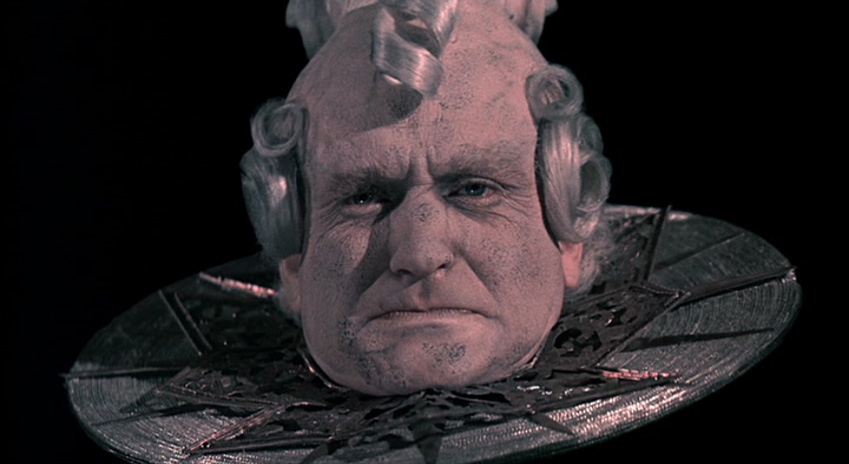
It's utterly remarkable when a movie such as this is known more for the chaos behind the scenes that in the finished product, and yet comes out as a very decent, solid effort. It isn't quite as epic or madcap as Brazil or as witty as Time Bandits, but the scale of the film sufficiently makes up for it. The visuals play out as though it were one of his Monty Python cartoons--they don't make a lot of sense, but then again they're not supposed to. And for the third review in a row, we get a WTF ending, this one more ambiguous than the other two.

Plus it has to be said: the fact that a director can put up with so much crap on the job--production delays, budgetary squabbles, miserable filming conditions (a young Sarah Polley found the experience particularly traumatizing) all for a studio that took his movie and threw it under a train--and yet make an entertaining movie that stands pretty well on its own just has to be applauded. If that isn't dedication to one's craft, I don't know what is.

And yet Gilliam's next film, The Fisher King, was also a Columbia-TriStar release.

So, how do these three films stack up against one another? Well, I'd recommend any one of them if you're looking for extravagant fantasy movies, and they all carry the theme of escapism and silliness in a world soured by rules, red tape and too much modern convenience. They all include scenes of one or more of its characters hanging from suspended cages. They have very strange endings, what with Time Bandits' exploding parents, the climax of Brazil turning out to be all in the main character's mind, and then...this. They all have Jack Purvis and at least one other Python in them...

...

I guess for me it'd be Brazil one, Time Bandits two and Munchausen a very close three.

I don't like to complicate things.

"...oh, and by the way, you know that Seven Years' War? I started THAT one as well."

7/17/12

Time Bandits (1981)


Terry Gilliam was born in Minneapolis, Minnesota in 1940 and went to the Occidental College in Los Angeles where he got a degree in political science, but spent most of his time writing and making illustrations for campus magazines. His early inspirations included Mad magazine, which at the time was edited by a man named Harvey Kurtzmann; in fact, one of his early after-college jobs was for Kurtzmann's new humor magazine Help!, where it was during a photographic comic strip shoot that he met and first worked with famous British comedian John Cleese. Then in the late sixties, he and his family moved to England and took British citizenship, and through Cleese's connections he got a job at the BBC, as an animator on the subversive children's series Do Not Adjust Your Set.

After Do Not Adjust Your Set ended, Gilliam and three of the show's cast members collaborated with Cleese and one of his comic cohorts to produce an adult sketch comedy series.

And thus was born:


Gilliam is best known as the off-camera member of the Monty Python troupe. His main contribution to the Flying Circus was more behind-the-scenes - he made the little cut-out animations that linked the live-action sketches together. As the series went on, he eventually started appearing more and more on stage and started moving away from making cartoons, and by the time he made his directorial debut alongside Terry Jones with Monty Python and the Holy Grail, he had caught the directing bug. His first solo gig as director was the 1977 cult movie Jabberwocky, which wasn't very well received by critics and audiences but was the first of a number of movies that would go on to achieve cult status.

For the next few updates we will look at a specific trifecta in his filmography unofficially refereed to as


Nice, huh? Made it myself.

Three Terry Gilliam movies made throughout the 1980s that examine the world of imagination through the eyes of three different people.

TIME BANDITS
through the eyes of a child.

BRAZIL
through the eyes of a white-collar worker.

And
THE ADVENTURES OF BARON MUNCHAUSEN
through the eyes of an old man.

Come with me now to a three-ring circus of fantasy, escapism, and eye-popping cinematography. Plus, if you're all real good, I'll give you a treat when we're done.


All the dreams you've ever had...and not just the good ones...


The 1980s were a golden age for sci-fi/fantasy movies. Before hobbits, teenage wizards and CG effects dominated the market, you had movies like Labyrinth, The Dark Crystal, Tron, The Neverending Story, Gremlins, Ghostbusters one AND two, the original Indiana Jones and Conan the Barbarian movies, two of the first three Star Wars films, Blade Runner--groundbreaking films that set benchmarks for the genre and have withstood the tests of time, harsh critics and varying degrees of success at the box office to become the cult classics we know and obsess over on the Internet today.

And who better to get a piece of the action than Monty Python's in-house animator?

Produced by ex-Beatle George Harrison's movie company Handmade Films, the people who brought you Life of Brian, Nuns on the Run and Lock, Stock and Two Smoking Barrels, Gilliam's third ever film Time Bandits was his attempt to make a whimsical, family-friendly fantasy movie in hopes of persuading the people at Handmade to get a little film he had written titled Brazil made. He hadn't done a film in two years when shooting began, and the only studio that would distribute it was a mid-major that hadn't had a hit in a long time, so he wasn't certain it'd sell twell, but it went on to become his most successful film in America and went on to set the tone for his future films.

The film stars a young child named Kevin (young Craig Warnock), a very imaginative boy who is very fascinated with history, who lives with his parents who are more obsessed with sitting on their plastic-wrapped furniture watching corny prime time game shows, talking about fancy high-tech appliances and yelling at Kevin for making too much noise.

That night after he goes to sleep, a white knight on horseback crashes through his closet door and runs through a sylvan glen that used to be his bedroom wall.

It turns out he dreamed this.

Not much comes from this scene, as it is never brought up again for the rest of the movie.

The next night, armed with a camera, a satchel and a flashlight, Kevin goes to bed awaiting the next strange thing coming through his bedroom.

And something does.

It turns out to be six small men carrying a strange map and looking for a way out of his bedroom.

These small men are revealed to be former employees for the Supreme Being (or God or whoever you want) hired to help keep Creation running. Feeling unappreciated, they decided to steal a map of the time-space continuum and use it to travel through time holes, burgling people along the way. I can't really tell who's who amongst our merry men, but I CAN tell you that their self-appointed leader is played by notable midget actor David Rappaport, one of them is Kenny Baker, who is best known to us all as the lovable R2-D2, and another of them is Jack Purvis, of whom we'll be seeing quite a bit throughout this trilogy.

Their first stop is the Battle of Castiglione in 1796, where we meet the great French dictator Napoleon Bonaparte (Ian Holm), who is, true to the stereotype, short, but not only does he not feel insecure about it, but he's also obsessed with them. Especially when they're hitting each other with things. Naturally, he likes the bandits so much he makes them all generals.

Ehh, those other two guys are probably just compensating for something.

Next they travel to medieval England, where they meet Robin Hood and his band of--

Wait...isn't Robin Hood a fictional character?

Ehh, he's played by John Cleese, so who cares.

(Speaking of fellow Pythons, look for co-screenwriter Michael Palin appearing with Shelley Duvall a couple of times as an ill-fated couple the bandits keep running into.)

"You call me 'Little John', I'll smash yer face in."

Throughout all this, they are constantly monitored by a being known only as Evil (played by David Warner, whom you may remember was all three baddies from Tron) and his cadre of plastic-wrapped minions. Evil has harsh criticisms for the Supreme Being's designs for the universe ("Forty-three species of parrot! NIPPLES FOR MEN! SLUGS!!") and feels he would run things much better if he and his more technologically-minded...mind were put in charge. So he tricks one of the bandits to suggest they travel to his lair at the Fortress of Ultimate Darkness within the Time of Legends, where the Most Fabulous Object in the World exists, so he can steal the map and rewrite the universe to his whims.

Yeah. Fortress of Ultimate Darkness. Nothing can happen to them there, right? And hey, the Most Fabulous Object in the World. I'd say that's worth a trip.

"Wait till they get a load of ME."

Kevin gets separated from his companions and visits ancient Greece, coincidentally his favorite period in history. He arrives in time to save the life of King Agamemnon (played by Connery...Sean Connery) and the two of them hit it off really well. The king even decides to adopt him and throws a huge party to celebrate...which the bandits crash to rob him and take Kevin back with them.

Kevin's had so much fun in ancient Greece that the boat ride he and his friends have wound up on isn't doing much to lighten his now-sour mood.

Neither is the fact that the boat they're on turns out to be the Titanic.

"So, Kevin, where did you go over summer vacation?"

Right about now, Evil takes it upon himself to jump start the plot and send them through a hole straight to the Time of Legends.

From this point, things get kinda surreal.

*ahem*

They hijack a ship manned by Peter Vaughan dressed like an ogre and his wife from Who's The Boss, hitch a ride on a giant's head and break a giant pane of glass to reach the Fortress of Ultimate Darkness, where Evil uses illusions of a brand-new kitchen set and Kevin's parents as his "Most Fabulous Object in the World" ploy to trap them and run off with the map. Kevin and company escape and steal the map back, one of the bandits gets turned into a pig, another one of them dies, and the other ones look for time holes and come back with a space rocket, a tank, some knights, some cowboys and some archers, none of which turn out to be very effective against Evil, but before HE can launch an attack of his own, he suddenly turns into stone and...explodes.

I don't think the description in the previous paragraph does that whole chain of events justice. You're gonna have to watch it for yourself to see how crazy it is.

"It's only a model."
"Shh!"

Then the Supreme Being shows up in the form of Ralph Richardson in a fancy suit. He recovers the map, changes everything back to normal, rehires the bandits and orders them to clean up the mess, particularly all the chunks of concentrated Evil lying around. They leave Kevin behind wondering why they're leaving him behind, with a smoldering chunk of David Warner they forgot to pick up .

Then Kevin wakes up in his bedroom to find it filled with smoke and some firemen (one of whom looks very much like Agamemnon) breaking his door down to rescue him. Seems his house caught on fire while he was asleep and his parents were too concerned with saving their appliances to see to the safety of their offspring.

Kevin finds out he still has the Polaroids from his adventures in ancient Greece, as well as the one with his midget friends holding up the map.

It turns out the source of the fire was a bit of concentrated Evil in their toaster oven. Despite Kevin's warning, his parents touch it and...explode.

Yes. This actually happens.

Then the firemen just...ride off.

And then...the credits roll.

There's your metaphor: finding a turd in your fancy-schmancy newfangled toaster oven.

Time Bandits has one of the most double-u-tee-eff endings I've ever seen in a movie. Kevin's parents are obviously an argument against modern materialism, and you could say they get what they deserve in a sense, but it kinda comes right out of nowhere, and with everything else that happens, it gets a tad confusing. It's sort of implied that Kevin could probably go looking for a time hole and have his own adventures, now that he doesn't have a materialistically-grounded Mom and Dad holding him back, but it's laid out so loosely that it's hard to understand what's going on if you're watching it for the first time.

That's really the only major complaint that I have, because other than that, the movie's pretty good. The dialogue is very witty, the visuals and special effects are breathtaking, and the characters are very energetic and rambunctious. Some of it might be a little scary for the more sheltered, impressionable kids, but everyone else should have a ball.

One down, two to go...

Hey, look..."Mini" Python's Flying Circus! Heh heh...sorry.